Search This Blog

Friday, February 24, 2012

Sindh Being Taken Away From Sindhis


By Aziz Narejo

Sindh is home to the Indus Valley Civilization with thousands of years of glorious history behind it. It has its own distinct culture, language, literature, heroes and villains. It has remained an independent country for hundreds of years during the known history. It has also been invaded and occupied at times. At all the times, Sindhis have owned, protected and promoted their distinctive social and cultural values, language, music and common heritage. They have resisted invaders and jealously guarded their identity throughout the history. Their heroic struggles in 1930s for the separation from Bombay and the anti-One Unit movement during 1950s and 1960s for the revival of the provincial status are but just a few examples.

When a resolution was presented by G.M. Syed in the Sindh Assembly in 1940s to become part of Pakistan, a number of Assembly members had resisted it fearing that Sindhis will lose their basic rights, language and culture as they will be a voiceless minority in the new country. They had instead favored a Dominion status for Sindh with an eventual independence.
G. M. Syed
They were assured by Syed and other pro-Pakistan leaders of that time that Sindh will have complete sovereignty over its territory according to the 1940 Lahore Resolution (also known as Pakistan Resolution) and all of its rights will be fully protected. It is most unfortunate that the fears expressed in Sindh Assembly in 1940s have come true and Sindhis have suffered immensely since the creation of Pakistan, as their life, culture, language and common heritage has been under an unprecedented and continuous attack and their lands, properties and resources have been encroached. 

The aspirations of Sindhis who participated overwhelmingly in the struggle to end the British rule in the earlier half of the 20th century were dashed soon after the “independence” in 1947. They had hoped to regain their lost glory at the end of the British rule but instead were enslaved by the immigrants and the rulers of the newly established country. They have since then faced state terror, aggression, suppression, murder and incarceration of their leaders, loss of political power and continuous denial of their basic rights. It is most tragic that they have endured the worst kind of violence and brutality in Pakistan.

It is a historic fact that the movement of population on a mass scale was not foreseen at the time of the partition nor was it part of the plan announced on June 3, 1947 for the division of India. Nonetheless, a huge population movement took place and Sindh was inundated with a sea of refugees. Taking into account the impacts of the migration on such a large scale and the bloodshed accompanying it, the leaders of the two countries signed an agreement in 1950 aimed at stopping the movement of population. It is regrettable that the immigration has continued unabatedly since then raising the fears in Sindh that Sindhis may lose majority in their own province in near future.
M. Ayub Khuhro (first from left) seen with M. A. Jinnah, Liaquat Ali Khan & other Muslim League leaders during the  ML Working Committee meeting in Bombay in 1942
It may be noted that the government of Sindh’s Premier Ayub Khuhro was dismissed in 1948 mainly because he refused to take more than 150,000 refugees and also because he had refused to handover Karachi to the Center and had intervened personally in the provincial capital of Karachi to end the violence against the Hindus, a religious minority in Sindh. It was said at the time that the first Prime Minister of Pakistan, Liaquat Ali Khan, an immigrant from India, and his supporters had instigated the riots to force the religious minority of Sindh to migrate to India.
Liaquat Ali Khan
It is also said that the leadership of Pakistan at that time had planned to settle a large number of refugees in Sindh to establish dominance over the province. In this context a conversation between Altaf Gauhar, information secretary in Ayub regime and Chaudhry Mohammad Ali, ex-prime minister of Pakistan on 15th March 1969 on the grievances of the people of Sindh is most revealing. Chaudhry Mohammad Ali in the conversation, as quoted by Altaf Gauhar said, “The Sindhis were extremely unhappy about the growing presence of “outsiders” in the towns of Sindh. The Muhajirs had taken over the whole of Karachi, the Punjabi officials had acquired the large tracts of barrage lands and the Pathans had acquired a monopoly of all transport and construction business”. Muhammad Ali thought these worries were all unnecessary because his “government in the 1950s had foreseen the problem and had planned the induction of Muhajirs into Karachi and other major towns of Sindh to forestall Sindhi nationalism”. (Please see pages 466, 467 of “Ayub Khan” by Altaf Gauhar).
Chaudhry Mohammad Ali
It is indeed part of the history that new laws were formed and immigrants were settled in the urban and rural areas of Sindh on a large scale. No verifications of claims were made for the allotments of evacuee properties and agricultural lands. Similarly no verifications were made for degrees or certificates of education for the employment of refugees. Simply a claim or a letter by the applicant cosigned by an officer, both immigrants, was deemed enough for allotments of lands, properties and employment.
Altaf Gauhar with president Ayub Khan & a civil servant M. H. Shah on the morning after 1965 presidential elections
On the other hands Sindhis were virtually banned from buying urban properties and agricultural lands in their own province. Later on when barrages were constructed to irrigate more lands in the province, the advertisements for the allotments of lands were published in the Punjab and the people from that province and every where else where encouraged settling in Sindh.

The practices have continued depriving the indigenous people of the opportunities in their own province and elsewhere in the country. They have been denied political power since the early days of Pakistan. They have been denied the basic democratic right to self rule and the access to their share in the economic development in the country.

Independent studies and surveys show that poverty in rural Sindh has increased manifold since 1947. It is said that the gross income in the rural areas has decreased since the independence. Experts and historians believe that if the income of a person was Rs. 50 at the time of partition, it has been reduced to Rs. 25 today if one takes into account the respective monetary value.

The indigenous people of Sindh have been made alien to the decision-making bodies in Pakistan. They don’t have their share in the civilian and military bureaucracies. No Sindhi has crossed the threshold of a Brigadier in the military since 1947.

The language, culture and the common heritage of Sindh have suffered the most. A vastly developed Sindhi language has been denied its rightful place in Sindh and Pakistan. The demand to make it a national language of the country has been continuously denied giving that status to a language spoken by a small but very powerful minority in the country. Peaceful Sindhi culture and way of life have been sidelined and an alien and mostly jingoistic culture has been imposed in the province.

Sindhi language has been virtually banned from the urban areas despite laws to the contrary and the doors to education opportunities have been closed on the indigenous population. Sindhis have been denied admission to colleges and universities in Karachi. Similarly laws have been made to refuse employment in Karachi to Sindhis from outside the city. A planned campaign is underway to settle outsiders in Karachi and other urban areas while demolishing old villages of Sindhis in Karachi and Hyderabad. Illegal aliens are being issued national identity cards and migration from India, Bangladesh and other countries is being encouraged to establish an artificial majority in the urban areas of Sindh in order to eventually force partition of Sindh.

Such policies of the Pakistani establishment aimed at denying the genuine rights of the indigenous people of Sindh and efforts to bring demographic changes in the province will cause unprecedented catastrophe and will result in more bloodshed and civil strife. One hopes sense will prevail and the leadership will stop its short-sighted policies.


The article was published in the June 2007 edition of quarterly "Sangat" edited by the author. 

Saturday, January 28, 2012

Pakistan's Embassy in USA & Sindhi Americans

Sherry Rehman continued the tradition of Pakistani ambassadors in USA since last 6 decades to ignore Sindhi Americans as she addressed a so-called Pakistani Americans' gathering in Washington, DC seeking their support on Pak-US ties. No Pakistani ambassador in USA including Hussain Haqqani has ever invited representatives of Sindhi Americans to any embassy programs nor have they ever consulted Sindhi Americans on any issues facing them. It means Pakistani ambassadors in USA have never considered Sindhis as having to do anything with Pakistan. One must make it clear that Sindhi Americans on their part are not that eager to be part of any embassy programs either but this is something that needs to be taken into consideration by the state of Pakistan & its advocates.

Friday, December 23, 2011

Order Of The Day: Join Imran Khan!


اڄ جو حڪم: هڪدم تحريڪِ انصاف ۾ شامل ٿيو

فرمانِ امروز: تحریکِ انصاف میں شامل ہو جائو

Order Of The Day: Join Imran Khan!

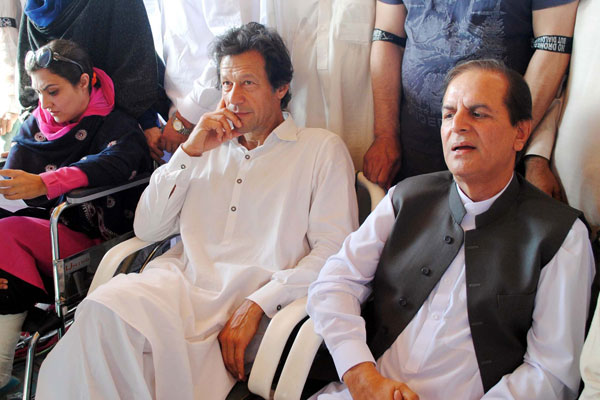
See how things change in Pakistan! It is really amazing! As if someone is pulling strings from somewhere! A few days back, Javed Hashmi spoke in Larkana from the platform of PML-N in the presence of his erstwhile leader, Mian Nawaz Sharif & outlined PML-N program vociferously. And today he has joined PTI & has left Multan for Karachi to join his new Leader, Imran Khan. Just like that!

The way politicians are joining PTI, the time is not too far away when Babar Awan, Rehman malik, Gilani, Ch Nisar Ali, Ch Shahbaz, Ch Shujaat, Altaf & of course Asif zardari & Nawaz Sharif will join the Khan too!

So who will be left behind from among the great Pakistani POLITICIANS? Hameed Gul, Musharraf, Kayani, Pasha & some other serving & retired generals? Well, you may never know. They may already be in it.

Politics In Pakistan: Black & White & Gray & SHAME & HYPOCRISY

Politics in Pakistan can not be described in black & white. More of it is in gray. And also in red - with the blood of so many. But it is mostly dominated by the colors of infamy, shame, hypocrisy, corruption, mismanagement, greed, barbarism, lies, deceit, terrorism, long boots, lotacracy (turncoats), injustice, massacre, rape, racism, discrimination & other crimes.

Wednesday, December 21, 2011

Mian Nawaz Sharif & His Party's Exaggerated Fear of Imran Khan & PTI

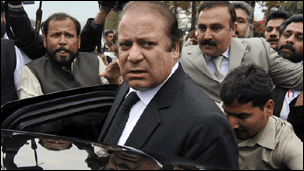
Could someone explain it to Mian Nawaz Sharif that the contest between PML-N, PTI and other parties in Punjab is political. Hence it should be handled politically. He didn't have to go to the Supreme Court of Pakistan to maintain his hold in Punjab and beat Imran Khan in next elections.

Memogate: Chief Justice Iftikhar Choudhry Should Not Judge, He Should Stand In Witness Box

Barrister Aitzaz & Chief Justice Iftikhar during the lawyers' movement in 2007
Memogate is certain to open can of worms in Pakistan. The legal battle is going to be stinky & very dirty. It has been pointed out that in case such memo was actually written to US officials, it had been done so in the response to a real threat of a coup by the military establishment. The whistle-blower, Mansoor Ijaz has pointed out in his black berry messages that a certain Mr. P (generally recognized as general Pasha, chief of Pakistani intelligence agency, ISI) had toured certain Arab countries, Saudi Arabia included, to pave the way for the overthrow of Zardari government.

It has also been said that the United States was approached even on the behalf of ex-prime minister Mian Nawaz Sharif, who is the petitioner in the case in the Supreme Court of Pakistan.

Several other political leaders and even generals are said to have approached the US officials for help in the past. The present Chief Justice of Pakistan, Justice Iftikhar Mohammad Choudhry is not an exception. It is said that leader of the lawyers' movement, Choudhry Aitzaz Ahsan had visited United States in 2007 to garner support for the deposed Chief Justice, Iftikhar Mohammad Choudhry. Hence it is demanded that the Chief Justice should recuse himself in the case & answer questions in this regards. So should do barrister Aitzaz Ahsan.

Tuesday, December 20, 2011

PTI, Imran Khan & The Change!

The C H A N G E ? Old is really "new"? Or is it? 
As pro Musharraf & pro establishment, old faces join the so-called new face of "change" in Pakistan, today's PTI is fast becoming yesterday's PML-Q. Aslam Beg & Hamid Gul had IJI, Musharraf had his PML-Q & now Kayani & Pasha will have their own hand-maiden, PTI! What a vehicle of c h a n g e for the unfortunate people of Pakistan. But some gullible still fall for such decoy! So get ready for the 'change' that comes via GHQ. 
Good luck, Pakistan!


Tuesday, December 13, 2011

What Is Going On In Dubai? Presence Of Several Pakistani Leaders, Their Associates, US Officials, Raises Questions


What is really going on in Dubai? Is any work underway on a new "Dubai Plan"? Many Pakistani politicians are either in Dubai these days or have visited the city recently. It has taken over from London, UK the position of being a place where most of the Pakistan related activities take place & deals are made. PPP-Musharraf deal was finalized in Dubai in 2007. Many other important meetings & negotiations have taken place in the city since then & before that.

Some reports say "anti-America", "Mr. Clean", Imran Khan along with turncoat Shah Mehmood Qureshi met with US general David Petraeus in Dubai on 29th November. The meeting is said to have lasted about 5 hours.

Zardari & some of his close associates are in Dubai. Musharraf along with his close aids is still in Dubai or was there until very recently. Musharraf’s party man, Dr Arjumand Hashmi, who is Mayor of Paris, a small Texas town has traveled to Dubai too. It was reported that he would join Zardari’s doctors’ team! Maverick doctor-politician is also a friend of PTI chief Imran Khan. IK has visited him in Paris, TX as has Musharraf. 
Dr Arjumand Hashmi, Mayor of a small Texas town, Paris & friend of Musharraf & Imran Khan
 So what is really happening there? Is any new alignment being discussed for a coalition after next elections? Imran Khan & Musharraf to be included in the new coalition? 

Gandhi & Sindh: Compiled by Khalil Chandio


Gandhi

“EVERYTHING IN INDIA attracts me. But when I first visited Sindh in 1916, it attracted me in a special way and a bond was established between the Sindhis and me that has proved capable of bearing severe strains. I have been able to deliver to the Sindhis bitter truths without being misunderstood” -- wrote Gandhiji way back in 1929.

Actually Gandhiji delivered to Sindh more sweet truths than bitter truths. And, in any case, all these truths indeed established a very warm relationship between Gandhiji and the Sindhis. He visited Sindh seven times --- in 1916, 1917, 1920, 1921, 1929, 1931, and 1934. It was “a Sindhi friend'' who had helped Gandhi shift from an expensive hotel to economical lodgings when he arrived in London for his law studies. In 1893, C.L. Lachiram, a Sindhi merchant, helped him organize the Natal Indian Congress. In 1899, Barrister Gandhi successfully fought for seven Sindhi traders who were being denied entry into South Africa. He supported the case of K. Hundamal, a silk merchant of Durban, in his articles in the Indian Opinion.

When Vishnu Sharma wrote a book on Gandhiji's satyagraha in South Africa and sent him a copy of the same, the latter acknowledged it with thanks. During his visit to Sindh in 1916, Gandhiji was presented with a welcome address artistically framed in Sindhi style. Gandhiji liked it so well that he kept it for years and showed it to visitors as an excellent example of Indian art. And it was Jairamdas who, in 1930, persuaded him to put everything else on one side and finish the autobiography, My Experiments With Truth.

However, the most important Sindhi leader in Gandhiji's life and work was Acharya Jivatram Bhagavandas Kripalani. Their first encounter in Santiniketan in 1915 was none too successful. Wrote Kripalani decades later: “Everything about him appeared queer and even quixotic.... I had never seen a middle-class educated man making a heavy meal of nuts, specially of such oily nuts as badams and pistas.'' Added the Acharya: “He was trying to know me and measure me. I too on my side was doing the same.''

A few months later Gandhiji set up an ashram in Ahmedabad and sent Kripalani a copy of its rules. Kripalani found the rules “very strange'' --- including the rule that husband and wife should live as brother and sister. He threw them away as ``impractical''.

And then one late evening in 1917, Kripalani got a telegram in Muzaffarpur from Gandhiji saying that he was arriving that night. He was on his way to Champaran to lead the indigo- growers' movement against their exploitation. Kripalani did not know what to do. As a bachelor-professor, superintending the G.B.B. College hostel, he did not have a house of his own. He, therefore, decided to put him up with his friend and fellow- professor, N. R. Malkani. But how was Gandhi, the ``great man'' of the South African struggle, to be received? The hostel students decided on a welcome with arati. But where to get a coconut for a proper arati, at night? While the students hesitated, Kripalani climbed a coconut tree in the hostel compound and plucked more than one coconuts. Gandhiji was properly received -and brought to the college campus in a horse-carriage lent on the spot by a local zamindar-friend of Kripalani --- and pulled by the students, against Gandhiji's wishes.
Gandhi with Acharya Kirpalani
Noted Gandhiji in his autobiography: “Acharya Kripalani, when I first met him in 1915, was already a seasoned warrior. He was then earning Rs. 400 per month but was a Brahmachari, taking only Rs. 40 for himself and sending the balance to Dr. Choithram who was conducting a Brahmacharya Ashram at Hyderabad (Sindh).'' Years later, Gandhiji wrote of that Muzaffarpur meet that ``since Kripalani had no rooms of his own, Prof. Malkani virtually became my host. It was an extraordinary thing in those days for Government Professors to harbour a man like me.'' He added that Kripalani, ``though a Sindhi, was more Bihari than a born-Bihari. He was my gate-keeper- in-chief. For the time being he made it the end and aim of his life to save me from darshan-seekers. He warded off people, calling to his aid now his unfailing humour, now his non-violent threats. At nightfall, he would take up his occupation of a teacher and regale his companions with his historical studies and observations and quicken any timid visitors into bravery.''
Jairamdas Doulatram
Dr Choithram
Professor N. R. Malkani
Even after this friendly encounter, the Gandhi-Kripalani relationship took some time to settle down to a happy, steady course. For example, Kripalani did not see how Independence could be won non-violently For Gandhiji, the course of Indian history had been non-violent; Kripalani thought otherwise. After some time Kripalani stopped putting questions to Gandhiji; he began to answer them himself. He now saw that India, in fact, was less violent than other countries; here, traditionally, only the professional warriors took part in fighting; in this country, children did not climb trees to destroy birds' nests; more people were vegetarian by conviction in India than anywhere else in the world. Kripalani the revolutionary had been converted to the cult of Ahimsa!

Even when the Himsa-Ahimsa issue was sorted out, Kripalani did not accept Gandhiji as “Mahatma''. He said: ``There were better and greater Brahmacharis than Gandhi. 1 never had any spiritual discussions with him. I also did not consider him a Mahatma. He used to call me Professor and I u-ed to call him Mr. Gandhi. After year. I called him either Bapu or Gandhiji. I rarely used the word Mahatma. As a matter of fact he resented people calling him Mahatma. Also Kripalani did not fancy Gandhiji's multi-religious public prayers; he thought prayer was a private affair between man and his Maker.

Kripalani supported Gandhiji's ` Khilafat'' movement to the extent that the British had promised to retain the Khalifa. But he did not agree with Gandhiji that if the Muslim anger was not channelized into the non-cooperation movement, it would have led to much violence. Kripalani viewed it only as an “expediency'' to get Muslim support for the freedom movement. Kripalani was sorry that Gandhiji's meeting with Jinnah in 1944 sent up the Muslim League stock. He felt that Muslims in India were more orthodox than Muslims anywhere else in the world because the Hindus were also very orthodox. And he once told me that Muslim cruelty and fanaticism could be traced to their neglect of the fine arts of music, dancing, painting and sculpture as “un-Islamic''.

After a few years, as Acharya of Gujerat Vidyapeeth, Kripalani went full-time into politics and became General Secretary of the Congress for more than a decade. He was of the definite opinion that there would have been no partition if we had followed Gandhiji. Gandhiji wanted to lead another struggle to wrest freedom for united India. But many leaders were too old and tired to wait that long for office. Gandhiji then “suggested that the British Government would be more anxious to back the Congress than the Muslim League. Therefore we had better try in that direction to checkmate Jinnah.'' But here again other leaders did not agree to join hands with the British and put Jinnah in his place.

Pandit Nehru even thought that the partition process would take ``at least ten years'' --- since the separation of Burma from India had taken that much time! Kripalani's plea for a “voluntary exchange of population'' was also brushed aside.

When violence erupted in the Punjab in March 1947, the Congress asked for “administrative division'' of the province. Kripalani saw in this clear seeds of partition --- and he rang up Gandhiji in Bihar to oppose the move. But, regrets Kripalani: “He was unfortunately surrounded by non-violent sadhus who did not understand politics at all. The phone was picked up by one such sadhu who insisted on my speaking to him only. What could I talk to that dunce?''

The fate of Indian unity was sealed.

Gandhiji's relations with Kripalani were not confined to public affairs. Right from the start, Gandhiji extended his interest to the whole Kripalani family. He wrote to Kripalani's father, Kaka Bhagavandas, assuring him that his grandson Girdhari was doing well in the ashram. He was always worried about the health of Kiki Behn, Acharya's only sister.

Kripalani was approaching fifty when he decided to marry Sucheta. “We had no intention but to live as companions. That is all we have been doing.'' But living together without formal wedlock would have only caused loose tongues to wag. However, Gandhiji would not bless the marriage. He was afraid he would lose a tried and trusted colleague like Kripalani. It was only when Sucheta assured him that, in their marriage, he would be gaining a new hand (Sucheta's) that he gave his blessings.

Nor did he hesitate to make fun of his dear friend, the Acharya. “Kripalani was morose formerly because I thought he was not married. But even when he is married and has a very good partner in life, his mood haunts him,'' he wrote early in 1942.

When Gandhiji suggested Kripalani for Congress President in 1946, Syed Mahmud and Yunus --- who were staying with Nehru --- opposed. Nehru himself opposed on the ground that Kripalani had a temper. Gandhiji countered: “But how about your temper?''

That clinched the issue. Kripalani presided over the Meerut session of the Congress. It was the period of transfer of power and Gandhiji said that Kripalani was “going not only to ear a crown of thorns but also lie on a bed of thorns. It is a much more difficult place than even the Cabinet members are filling.''

But within months Kripalani resigned because the Congress ministers, Nehru and Patel, would not consult the Congress President even on major issues.

Gandhiji told Sucheta on that occasion that Kripalani was going to play a bigger role in national affairs. He was right. From 1947 to 1977, Kripalani became the conscience of the country.

Gandhiji's relations with Acharya Gidvani were equally dear, except that the latter died too soon, in 1935. Gidvani resigned as principal of Ramjas College in Delhi, to head the Gujerat Vidyapeeth. Gandhiji said of him that he was “not only a scholar but, on the touch-stone of character, gold.''

The Sikhs were agitating in 1923 against the deposition of the patriotic prince of Nabha. Nehru, Acharya Gidvani and K. Santhanam went to observe the scene and were arrested, sentenced, and then sent out. When the atrocities continued, Motilal wired Gidvani to go and see on the Nabha border what was happening. On one occasion not only was a satyagrahi shot dead, his child, who was being breast-fed, was also shot dead. Gidvani thereupon rushed to the scene of firing just inside the Nabha state border. He was immediately pounced upon and kept in jail for almost a year. Writes Nehru in his Autobiography: “I felt inclined to go to Nabha myself and allow the (British) Administrator to treat me as he had treated Gidvani. Loyalty to a colleague seemed to demand it. But many friends thought otherwise and dissuaded me. I took shelter behind the advice of friends and made of it a pretext to cover my own weakness.''

Gandhiji noted: “He did not even wilfully cross the Nabha border. His humanity pushed him in.'' And when Gandhiji heard from Shrimati Gidvani after an interview that Gidvani was locked, his clothes were dirty, he looked much reduced as he had fasted for seven days, he wrote: “The whole of the civil resister rose in me and I felt like giving battle. But I realized my powerlessness and hung my head in shame. With an India cut up into warring parties and torn with Hindu-Muslim squabbles, civil resistance seems to be an impossibility. One's only comfort is that Acharya Gidvani is a brave man and well able to undergo all the suffering he may be subjected to. May God give him the strength to go through the fire!''

When Gidvani died prematurely, Gandhiji wrote: “Such servants of humanity never die. They live through their service.'' He collected a Gidvani Memorial Fund and built Harijan Hostel in his honour at Kheda in Gujerat.

Nor did he forget the Gidvani family. He greeted Ganga Behn as “the brave wife of a brave husband'' and gave her a letter of introduction that helped her set up an insurance business and bring up her young children.

Years earlier, Gidvani had told Gandhiji not to worry about petty personal things. But Gandhiji had told him: “The personal things you call petty are of as much interest to me as Bardoli, for I have to know all about co-workers.'' And he had added- “Tell Ganga Behn not to forget her Gujerati!''

Gandhiji had known Prof. Malkani since his stay with him in Muzaffarpur. Malkani was teaching at Gujerat Vidyapeeth when, in 1927, under pressure from his wife and persuasion from N.V. Thadhani --- then Principal, D.G. National College, Hyderabad Sindh --- he left Ahmedabad without consulting Gandhiji.

Gandhiji was shocked into penning some of the more moving letters of his life. He wrote to Malkani on 26 June: “I do not mind what happens to the Mahavidyalaya, but I do mind hat happens to a man. May God help you and me.''

Gandhiji wrote to Kripalani, then principal of the Vidyapeeth on 10 July: “It (the news) nearly broke me to pieces. For I regarded Malkani to be one of my unbreakables.''

And in a long letter to Principal Thadhani on 19 July he wrote: “Malkani standing at the helm of his sinking ship in Gujerat, himself starving, his wife and mother-in-law looking daggers at him, and his friends howling at him in indignation for his madness, would have been an ideal professor for your boys and a noble lesson for India.''

He went on: ''My life has been a witness of many such institutions (like the Vidyapeeth) arising and falling, with some of which I have myself been intimately concerned. For me, their worth has consisted in their having thrown up heroes and thus finished their task.'' He concluded: ``I may inform you that I have not yet got over the shock. Bardoli never disturbed me; but Malkani does.''

Gandhiji admired Sindh for giving so many excellent professors to the country. Referring to the Sindhi professors at the Gujerat Vidyapeeth as ``the treaty made between Gujerat and Sindh'', he asked the Gujerat students to go as flood relief workers to Sindh and repay ``the debt to Sindh''.

However, perhaps his sweetest relations were with Jairamdas. At the Amritsar session of the Congress, 1919, acute differences had arisen on the reforms resolution between Gandhiji on the one hand and Tilak, C.R. Das and Mohammed Ali on the other. Recalled Gandhiji years later: ``Jairamdas, that cool- headed Sindhi, came to the rescue. He passed me a slip containing a suggestion and pleading for a compromise. I hardly knew him. Something in his eyes and face captivated me. l read the suggestion. It was good. I passed it on to Deshbandhu. 'Yes, if my party Will accept it' was his response. Lokmanya said, `I don't want to see it. If Das has approved, it is good enough for me.' Malaviyaji (who was presiding anxiously) overheard it, snatched the paper from my hands and, amid deafening cheers, announced that a compromise had been arrived at.''

When Gandhiji was launching the ``Salt Satyagraha'' in 1930, he wrote to Jairamdas, who was then member of the Bombay Legislative Council: ``I have taken charge of the Committee for Boycott of Foreign Cloth. I must have a whole-time secretary, if that thing is to work. And I can think of nobody so suitable like you.'' Jairamdas immediately resigned his seat, took up the new charge, and made a tremendous success of the boycott of foreign cloth.

When some Muslims alleged that Jairamdas was communal, Gandhiji told them: “I swear by Jairamdas. Truer men I have not had the honour of meeting. He is not anti-Muslim. I decline to think of him --- or of Dr. Choithram --- as anything but pro- moter of Hindu-Muslim unity.''

In 1941, when Dr. Choithram, President Sindh PCC, consulted Gandhiji on a particular issue, the latter told him: “Do as Jairamdas advises. My faith in his wisdom is a constant factor.''

Nor did Gandhiji confine his interest to leaders. He never forgot that he had disappointed the people of Padidan in 1919 by falling asleep at the time. He made it a point to visit that place when he visited Sindh ten years later! And he wrote any number of letters to and about Anand Hingorani and his wife Vidya, concerning their health, work, welfare. When Vidya died and Anand started worshipping her, Gandhiji wrote to him: “Vidya was good but cannot take the place of God. I am an iconoclast. If you can forget her easily, do so. Then Vidya will rise and also you.''

Gandhiji's humour infected even the Congress dames. He jokingly asked Ganga Behn Gidvani, who was doing insurance business, in 1936, to “insure'' his life. She joked back: “No, I will not insure an old man like you.'' After a meal with Malkani. he asked Shrimati Malkani for dakshina. And the tatter returned: ``I have given Malkani to you. What more dakshina do you want?''

All this interest in individuals was not only intensely human; it was calculated to promote the causes dearest to him. And these apart from Swaraj, were Khadi and Hindi. He was delighted when Acharya Gidvani draped Guru Granth Sahib, not in the customary silk or satin, but in Khadi. This, he said, was a great example to those who draped even the Puri idols in foreign cloth.

However, Gandhiji noted in 1924 that the Sindhis did not take Khadi seriously. He found Sindh yarn “a sorry affair'', with “little trace of practised spinning''. Even years later he noted that ``with a few honourable exceptions, they are not interested in Khadi. Want of faith is the father of an innumerable brood of doubts.'' He found that Kotri had only 20 Congress members, whose number would be reduced to two, if Khadi-wearing was insisted on. What surprised him most about Sindh's neglect of Khadi was that it had an abundance of cotton --- and lot of poverty. As proof of Sindh's poverty, he quoted the large number of pies he got in his collection. “Apart from Orissa, I have never found so many pies in my collection as in Sindh. In one place I found even cowries among the collection. (The old rupee had 64 paise; one paise was equal to three pies; and five cowries made one pie). This could not be attributed to miserliness. Stinginess I have never experienced in Sindh. A people who gave over Rs. 70,000 in 12 days (for the Rs. 5-lakh Lala Lajpatrai Memorial Fund) could not be considered unwilling.''

Gandhiji was particularly upset when Jamshed Mehta, the mayor of Karachi and a great Congress sympathiser, moved a resolution in 1928, to rescind the earlier 1924 resolution of Karachi Corporation, prescribing Khadi uniforms for Corporation peons and scavengers. Jamshed's argument was that during the preceding three years, the Corporation had spent one lakh rupees on Khadi, 85 per cent of which was a waste. Khadi, he said, soiled sooner and wore out faster --- and the poor chaps were entitled to only two dresses a year. Said Jamshed: “I tell you it is really a cruelty. The stuff we are now giving our peons is enough to bring tears in one's eyes.''

Gandhiji wrote: “Jamshed Mehta is rightly accepted as the - truest man of Karachi. Almost every good public movement there claims him as its own.... His honesty and independence areas unquestioned as his patriotism.'' But Jamshed's judgement on Khadi “is very like that of a delicate lady, judging the appetite of her weather-beaten guests by her own.''

Of course poor Jamshed had already withdrawn that resolution on the objection of the Congress corporators. But a few years later, Gandhiji himself adopted the argument of Jamshed --- on the subject of Harijan housing in Karachi. Replying to the Address of Welcome, he told the Karachi Corporation in 1934: ``The city fathers should see to it that not a single Harijan was housed in quarters in which they themselves would not consent to live.'' Later he told a public meeting in Karachi: “It does not redound to Karachi's credit that a single Harijan within its limits should be compelled to live in a house which the tallest .of its citizens would not gladly occupy.''

Jamshed had not been seeking anything different --- for their clothing!

During this same visit in 1934, Gandhiji met the Karachi press. When K. Punniah, the editor of the Sind Observer asked him about -the separation of Sindh from Bombay, Gandhiji excused himself and said: ``Now you are taking me out of my depths.''

When asked about his impressions of Sindh, he said: “My impressions of Sindh have been very happy. I should have been happier if I could get more money.'' Thereupon the pressmen happily collected 30 rupees on the spot. Gandhiji said: “I do not want to rob you of what little you get. At least give me your pencils.'' And so Gandhiji took both 30 rupees and the pencils, amidst general laughter.

Again and again Gandhiji was asking the leaders and their wives and their children --- and whoever else would listen --- to learn and use Hindi. He even wrote to Sucheta in 1945 to ask Kripalani to “write to me in Hindi or Urdu or Sindhi. Why does he write in English? Is it because he is a `professor'?''

And he was quite-horrified by the Sindhi custom of “Deti-Leti'' (Dowry) particularly among the Amils. He told the D.J. Sind College students in 1934: “Here they try to imitate the sahibs and the Parsis. When I saw the girls during my first visit to Sindh, I wondered how there were so many Parsi girls around. Later on I came to know that they belonged to the Amil class. I was familiar with the name “Bhai-band'' (the business community). But I was rather scared by the name “Amil''. I wondered what kind of people they would be. When I saw the Amils I found them exactly like the Sahibs.''

Gandhiji added: “The Amils of Sindh are probably the most advanced community in that province. But in spite of all their advance, there are some serious abuses of which they seem to have monopoly. Of these the custom of Deti-Leti is not the least serious.... The parents should so educate their daughters that they would refuse to marry a young man who wanted a price for marrying and would rather remain spinsters than be party to the degrading custom.''

When Malkani informed him that he had spent only 2000 rupees on the wedding of his daughter Mithi, Gandhiji wrote back on 4 October, 1928:

”If it was not tragic, I should have a hearty laugh over yourconsidering the expenses of Rs. 2,000 a little thing. Ramdas' marriage cost me probably one rupee, that is one or two coconuts and two taklis for the bride and the bridegroom, two cop- ies of the Gita and two copies of the Bhajanavali. Rs. 2,000 in Gujerat will be considered a fairly large sum even outside the Ashram limits. I do not think that even Jamnalalji spent Rs. 20,000 over Kamala's wedding two years ago. But I know that if I measured Sindh by Gujerat footrule, it would be a hopelessly false measurement. I suppose for you it is progress from Rs. 20,000 to Rs. 2,000. You will perhaps have to renounce your mother-in-law and to have a divorce from your wife. Considered from that point of view, Rs. 2,000 is perhaps not a bad; bargain.''

It was left to Hassanad Jadugar (magician) to set an example in dowry-less marriage. He gave his daughters only five Ch's: charkha (spinning wheel), chaadi (milk-churner), chakki (grinding-stone), chulha (native stove) and chaunri (metal buc- ket).

When Muslim League minister Khuhro was charged with the murder of Allah Bux, the former nationalist Premier, he tried to engage Jinnah to defend him. But Jinnah refused. (Incidentally, it was a Sindhi, Vasant T. Kripalani, who persuaded Jinnah to take up his last case in life --- and that too only in a city magistrate's court in Agra! --- vide. The Indian Express, 27 March 1983.) Khuhro then approached Bhulabhai Desai, who agreed. Dr. Choithram protested to Gandhiji about it. Gandhiji thereupon wrote to Bhulabhai: ``I do not hesitate to request you that if after examining the papers of Khuhro's case you feel that he is -innocent, you should fight for him, but if you feel that he is guilty, you should advise him to plead guilty or ask him to relieve you.'' Bhulabhai went out of the case but Khuhro was saved from the gallows by a Hindu lawyer, Dialmal. Immediately after, Mr. Wells, Sessions Judge, who had tried the case, retired prematurely in mysterious circumstances, and left for UK.

Way back in the Nineteen-Twenties, Gandhiji reported: “I have just received from Dr. Choithram the alleged facts of an attempted forcible conversion of a Hindu in Sindh. The man is said to have been done to death by his Muslim companions because he will not accept Islam. The facts are ghastly if they are true.'' Gandhiji referred the matter to Sir Abdullah Haroon, a Muslim leader of Sindh, who alleged suicide, promised to inquire, and then sat silent over the matter.

When violence gripped Sindh from 1939 onwards, Gandhiji raised his voice against it. He warned that ``what happens in India, whether good or bad, in one part, must ultimately affect the whole of India.''

His “real remedy'' for the Hur menace was that the Congress MLAs should resign their seats and the Allah Bux ministry should resign and all of them should “form a Peace Brigade and fearlessly settle down among the Hurs''. The Sindhis did not think it quite practicable, one MLA, Seth Sital Das, having already been shot dead. One press correspondent even wrote to Gandhiji: “Instead of asking the Sindh MLAs to resign and go to the Hurs, why should you not send a 'company' of your trained satyagrahis and try the luck of your doctrine?.... Or i8 it your case that your satyagrahis will meet the danger only when it reaches the Ashram?''

When the Hindus complained of continued systematic violence against them in 1939, he told them to “learn the art of defending themselves''. And “if they do not feel safe, and are too weak to defend themselves, they should leave the place which has proved too inhospitable to live in.'' He returned to the subject in January 1940 and wrote: “I have suggested hijrat. I repeat the suggestion. It is not unpractical. People do not know its value. High and mighty have been known to have resorted to it before now. The Second Book of the Old Testament is known as Exodus. It is an account of the planned flight of the Israelites. In exile they prepared for a military career. There is, therefore, nothing wrong, dishonourable or cowardly in self- imposed exile. India is a vast country. Though poor, it is well able to admit of inter-migration, specially of those who are capable, hard-working and honest.''

And when in 1947 the Sindhi Hindus did begin to leave, Gandhiji wrote: “If even a single Sindhi leaves Sindh, it will be a matter of shame to Mr. Jinnah as Governor-General.'' He added: “The Sindh Hindus are first-class businessmen. Why are they running away to Bombay, Madras and other places? It will not be they who will be the losers, but Sindh. For they will make money for themselves, wherever they go. One finds Sindhis in South America. There is hardly any place in the world where Sindhis are not found. In South Africa they were making big money and gave of it liberally to the poor.''

Although the Sindhi leaders had the sweetest of relations with Gandhiji, be it said to their credit that they did not hesitate to speak up when they thought him wrong. Jethmal Parasram described the Khilafat as “aafat'' (catastrophe). And when Gandhiji asked Choithram in 1930 what Jethmal thought of the proposed “Salt Satyagraha'', he told him: “Jethmal says that in 1920 you wanted freedom with balls of yarn; now you want it out of ladoos of salt.'' Choithram reported that Gandhiji visibly slumped at the remark.

Gopinath had shot an Englishman, Mr. De. The AICC draft resolution condemned Gopinath's action. An amendment praised Gopinath's heroism. When Gandhiji opposed the amendment, Motilal Nehru and C.R. Das walked out. Gandhiji won the point, but in view of the walk-out, he said the amendment might be taken as passed. Thereupon, Choithram stood up on a “point of order'' and asked: “How can a rejected amendment be taken as passed?'' Gandhiji was shaken. With tears in his eyes, he said: `Choithram, who is like a child to me, is now raising points of order with me. Today I stand alone.'' The point of order was drowned in the tears of Gandhiji, Choithram and Mohammed Ali, who now placed his cap at Gandhiji's feet.

When there was an attempt on the life of Lord Irwin,. Gandhiji wanted the AICC to condemn it. Swami Govindanand opposed. In the vote that followed, Gandhiji won by only 38 votes in a house of about 700. Gandhiji graciously conceded: “the moral victory was with Swami Govindanand.''

In the AICC meeting in October 1934, Gandhiji moved an amendment to the Congress constitution, renaming the United Provinces as “Hind'', and the Central Provinces as “Mahakoshal''. Dr. Choithram opposed the amendment and said that UP could not be called ``Hind'', which was the name cf the whole country.

Shri C. Rajagopalachari supported Choithram.

Gandhiji said that he had agreed to the change only because people complained that they had no Indian name for UP. Now that there was an objection he was withdrawing his amendment. However, the members pointed out that they had no objection to CP being renamed Mahakoshal. Gandhiji accepted the new amendment and said amidst general laughter: “You seem to grudge poor Jawaharlal, who is inside the Naini Jail. It was he who had suggested that UP should be called Hind.''

During his last days, Gandhiji had P.B. Chandwani, former deputy general manager of North-Western Railway, staying with him in the Birla House. On 20 January 1948, a bomb exploded during prayer-time, and tore away a section of the compound wall of Birla House. At the end of the prayer meeting, Gandhiji said he thought it was only some military firing practice in the distance. Thereupon, Chandwani said: “Bapu, that is neither truth nor non-violence.'' Perhaps only a Sindhi ashram-mate could be that blunt.

When Partition came in spite of Gandhiji, he persuaded the Government of India to do everything for the refugees. He spoke to the Maharao of Kutch and got Kandla land for the Sindhu Resettlement Corporation. He told a Sindhi delegation, led by Dr. Choithram, on 30 January, 1948: “If there can be war for Kashmir, there can also be war for the rights of Sindhi Hindus in Pakistan.''

Professor Malkani met him only an hour before Gandhiji was shot. Malkani had been just appointed Additional Deputy High Commissioner to organise the migration from Sindh. Gandhiji gave him a resounding blessing-pat on the back with the words: “Take out everybody. See that you are the last to come out. And tell Khuhro I want to visit Sindh to re-establish peace. Let him consult Jinnah and inform me telegraphically.'' When Malkani told him how the Hindus in Sindh had to wear “Jinnah Cap'' and carry about an Urdu paper or Dawn to pass off as Muslims, for security reasons, he said he would mention it in his prayer meeting that evening. Alas, he died before he could visit Sindh --- or expose `the excesses there!

Khalil Chandio

Sunday, December 11, 2011

Zardari Survives? But At What Cost? How Long?


Looks Zardari has survived another attack. This time it seemed to be fatal one. There must have been some collateral damage. Soon we may know its extent. But no one should be complacent. This will by no means be the last attack against the president & the democratic system by his haters & anti democracy forces. They might have already put the things in process for their next move.

It is for certain that the things will remain the way they have been for long until some basic questions are addressed. The powers that be have to be reined in. They have to be made to respect the Constitution. The national question will have to be settled. And the provinces will have to be given their full rights.

Friday, December 9, 2011

US-Pakistan Relations: “COMPLICATED”!

There is a question in the profile section of the facebook about the “relationship status”. Many people answer that question as “complicated”. Well, that answer truly reflects US-Pakistan relations: They ARE c o m p l i c a t e d!

PPP Needs To Re-evaluate It's Policies


Zardari may return, with broken wings, powerless & as a mere figurehead like Fazal Elahi Chaudhry or Rafiq Tarar; he may even resign as party co-chairperson or become inactive in that position & let Bilawal become more active. But will that be a solution to the problems Pakistan or PPP face? I don't think so. Much more needs to be done. Some heads have to roll & some basic re-evaluation of PPP policies have to take place. People like Faryal, Babar, Rehman and many more must go. People like Aitzaz & Rabbani should be brought in. Corruption, nepotism must be checked. 


Most important is to go back to Benazir Bhutto's policies and stand since her meeting with MNS in Jeddah & later signing of CoD in London, UK. Their written & unwritten agreements must be followed. PPP must change its attitude towards judiciary. It should distance itself from pro-Musharraf parties & try to work with PML-N. It is the need of the hour that PPP & PML-N join hands at this moment to foil the conspiracies hatched by anti-democracy forces. (8 December, 2011)


Most analysts agree that the real Pakistai rulers since last 60 plus years are now fed up with Zardari. But they are not willing to put Nawaz Sharif in the driving seat again either. Why then MNS has taken upon him to dislodge Zardari government through Supreme Court. Does he have any false assurances or any illusions or is he unwittingly paving the way for military establishment’s hand picked man, Imran Khan to come to power? (7 December, 2011)


Presence of Osama bin Laden next door to Pakistan's premier military academy in Abbottabad was a smoking gun against military establishment. They kept lying. No accountability. When elected PMs wanted peace with India, they were either overthrown or sabotaged with conspiracies like the abortive Kargil offensive. When an elected president talked of an agreement on no-first use of atomic bomb & industrial zone on the borders with India, they planned terrorist attack in Mumbai. They have been defeated in all the wars with India but have conquered own country FOUR times & are eating away most of country's budget & have become biggest industrial & commercial enterprise in the country. 

They killed, raped & injured hundreds of thousands of people in Bengal yesterday & are repeating the same in Balochistan today, no questions asked. Murder of Bhuttos, Bugti & several more is on their hands. 


Thousands have sacrificed for an end to military role but their sacrifices seem to have gone in vain as they again are staging comeback using anti-American bogey today. What a waste! (30 November, 20110


Friday, December 2, 2011

27th December: Get Ready For Another Zardari-Rehman Malik Drama


27th December is almost upon us. Get ready for another Zardari-Rehman Malik drama about “catching” & “punishing” the “killers of Shaheed BB”. It is about 4 years since the PPP chairperson was assassinated in Pak Army town, Rawalpindi. Her party, led by her widower & son, has been in power for 3 years & 9 months since then. First they delayed any meaningful investigation in the name of UN probe. When UN commission submitted its report, they rejected it & refused to act on it. Then they said they would hold their own inquiry. Now their hand-maiden report is ready since more than a year but they won’t publish or disclose it in full. Last year, they delayed the arrival of the 'son' in Garhi Khuda Bux for a day & issued an statement afterwards that since he couldn't attend the party CEC meeting, the report could not be announced on BB’s 3rd death anniversary.

In between, they have not shown any seriousness to go after the killers. Instead they have been seen as an impediment in the case being heard in a Rawalpindi court. They have transferred, harassed or offered no cooperation to the public prosecutor & the judge. They haven’t done a thing to oblige the court order to bring ex-military dictator Musharraf to the country to appear before the court, as he is the main accused. What new drama this year? Wait & see! 27th December is not too far away.

Worrying About "Memogate"? How about "Veenagate" Now?


So you have been worrying too much about the so-called memogate? How about "Veenagate" now? Controversy-prone Pakistani actress, Veena Malik is in the eye of another storm as an Indian fashion magazine, FHM, has published an almost nude picture of her on its cover. What may be more disturbing for the pseudo patriotic elements in Pakistan, including the sleuths, fundos, IK, MNS, Choudhry Iftikhar & others, is an unpardonable sin of sporting a tattoo on her arm, reading ISI!

VM says the photos are 'morphed'. FHM says pictures are genuine & they have proof including a video of the shoot & emails from VM.

So will the ultra patriots go to Supreme court now against this actress blaming her of defaming the country? And more sinful at that, doing so in the "enemy" country? Or will Choudhry Iftikhar take a suo mottu notice? God may be with this poor actress & save her from vultures in "Pak Vatan".

Memogate & Mian Nawaz Sharif


MNS in black coat & tie, ready to plead in Memogate case before the SC
Pakistan's Memogate:


Memogate is certainly somebody else's war. Mian Nawaz Sharif should not have got involved in it. He might have been competing with Imran Khan, thinking that if he didn't, Imran Khan might take it to the Supreme Court & score few more runs in the match to take Punjab Trophy. Is that what politics has come to in Pakistan? No, but that is how politics has always been in Pakistan! Very disappointing!

Friday, October 28, 2011

Begum Bhutto remembered: By Kamran Shafi

When I see the carping on Twitter, and various blogs and discussion boards and what have you, complaining about the holiday to mark the passing of Begum Nusrat Bhutto; or about the government flying journalists to Larkana to cover her funeral, I am further convinced that a whole lot of young Pakistanis simply do not know this country’s tortured history.

Which is not their fault: the mass (Urdu) media, both print and electronic, instead of periodically reminding the nation of its real heroes and heroines (and their tribulations at the hands of army dictators), is much more taken up with trashing our politicians, the pet hate of the Deep State.
You might ask why I introduced the term ‘tribulation’ so early in this piece. Simply because, dear reader, Begum Nusrat Bhutto’s life after the assassination of her husband was, for many many years, one long and painful ordeal, and yes, one of great tribulation.

It began with the arrest of her husband, the former (for Zia had already carried out his coup against the elected government) elected prime minister, and president of Pakistan, on what were quite apparently trumped up charges; his release on bail; and his rearrest under Martial Law Regulations after tens of thousands of people turned out in Lahore to welcome him when he visited that city after his release.
Then came the murder trial in the Lahore High Court under the Chief ‘Justice’ himself, the malevolent Maulvi Mushtaq, an avowed and declared Bhutto enemy who refused to recuse himself even after ZAB said he had no faith in him. If the conduct of the trial was disgusting for outside observers like I, how painful must it have been for Begum Bhutto to daily see needless indignities heaped upon her husband?

One little story to do with the dastardliness of Maulvi Mushtaq. One day, as ZAB was brought out of Kot Lakhpat Jail to the police van that transported him to court, he saw that the chair he used to sit on in the back of the van had been removed. When he asked why, he was told there were ‘orders’ that he should sit on the wooden benches along the sides of the van.

ZAB refused and said in that case he would not attend court that day. Telephone calls flew back and forth, and the ‘orders’ were withdrawn. When the court assembled, Maulvi told ZAB to stand up and to keep standing for that day’s proceedings. When Bhutto protested, saying he should not be treated that way for he was, after all, a former president and prime minister, Maulvi flew into a rage and reportedly shouted: “You are a criminal; you will sit wherever you are told to sit… one more word out of you and I will have you whipped in jail!”

While he was being treated thus, his wife and daughter were also at the receiving end of the dictator’s malice. On December 16, 1977, a mere five months after her husband was removed from the elected office of prime minister, Begum Bhutto and her daughter, the much missed, much lamented Benazir, were lathi-charged by the police while they were watching the England-Pakistan Test match at the Gaddafi Stadium in Lahore just because the crowd raised ‘Jeay Bhutto’ slogans. Photographs of Begum Bhutto, her forehead dripping with blood, have appeared widely over the internet over the past few days.

The scandalous trial went on: Maulvi’s court sentencing ZAB to death and the Supreme Court rejecting his appeal, with four Punjabi judges convicting and three non-Punjabi judges acquitting him. Despite this split verdict and against all judicial precedence, ZAB was hanged in Rawalpindi Jail on April 4, 1979. I might add that whilst I am a Punjabi myself, it is important to speak up about the ethnic make-up of the bench.

Zia did many a monstrous thing, but one of the most monstrous was when he refused to let Begum Nusrat Bhutto and Benazir attend the last rites of their husband and father! How ‘pious’ this charlatan was can be judged from just this one act. Which Muslim will keep a person’s family from burying their own? Pakistan’s army dictators — the Commando did the same with Nawaz and Shahbaz Sharif when their dear father died — and, of course, the wild hordes who beat Muammar Qaddafi to death.
The graceful Begum Bhutto took all that was thrown at her with great stoicism and courage, and in due course started an agitation which led to the Movement for the Restoration of Democracy that showed the world that the tyrant was vulnerable. If Begum Nusrat Bhutto has been named the ‘Mother of Democracy in Pakistan’, she fully deserves the title.

I end with a personal anecdote: in the spring of 1988, after I had accepted Prime Minister Benazir Bhutto’s offer to work for the government as public information officer (PIO), Begum Bhutto sent for me. She recounted how she and ZAB knew my father and family and asked if I would come work for her on her staff. While I was delighted, I said, “Begum Sahiba, thank you, but the prime minister has just yesterday asked me to work for the government as PIO”. “Really” she said, and then smiled so very warmly. “Well, at least you will be with us”.

And then she started to cry. “They have been so horrible to us… you cannot imagine what they have done to us… even accusing Zulfikar of buying a personal chandelier with government money… but I have the receipts… you know, he would pay even the smallest personal bill in the PM’s House by cheque… and when I said why he was bothering writing a cheque when I had money in my bag, he would say, ‘Nusrat you don’t know them; they will say and do anything to destroy me and my name… I must have records…’”.

I am exhausted dear reader… more another time… may the Almighty give strength to those who loved her.

RIP, Begum Sahiba.
The writer is a columnist, a former major of the Pakistan Army, and served as press secretary to Benazir Bhutto


Courtesy: daily The Express Tribune, October 28th, 2011.

Wednesday, October 12, 2011

Benazir Bhutto’s Alleged Murder Plotter Joins PML-N, Shaikh Rasheed to Follow

By Aijaz Ahmed

Islamabad:  Pakistan Muslim League (N) proudly calls itself a principled party and claims it is against 'lotacracy' and that it always abides by the Charter of Democracy. It also uses the name of Benazir Bhutto whenever it’s leaders want the government to go on the back foot. However its double standards have been exposed as the same "principled" party has allowed an alleged plotter of Benazir Bhutto's murder and a close associate of military dictator Musharraf and the Choudhris of Gujrat to join PML-N.

It may be recalled here that Benazir Bhutto had sent an email in 2007 to her lobbyist in Washington, DC and a family friend, Mark Siegel, containing four names who according to her were plotting her murder according g to her own information. The then Director General IB Brigadier (retd) Ijaz Shah’s name was one of the four suspects nominated by BB herself.

Former IB chief, Brig. Ret. Ijaz Shah
BB’s suspicion of her murder plot was not baseless. She was indeed brutally martyred at Liaquat Bagh in Rawalpindi on 27th December 2007. Brigadier Ijaz shortly after the general elections in 2008 ran away from Pakistan and settled in Australia with the blessings of the man at the helm of affairs at that time and he was no other than Musharraf. As Ijaz Shah was also known as a close friend of PML-N’s arch rivals, the Choudhris of Gujrat, the party had started an aggressive campaign when PPP joined hands with the Q league. It had blamed PPP of selling out the murder of BB “Shaheed”.


The PML-N had vowed to take revenge from the murderers if and when it formed a government in the center. But all the claims, love and respect for BB has proved to be false and a mere political stunt as Ijaz Shah who returned to Lahore few weeks back after a secret settlement with Punjab government has formally joined PML-N few days back and signed the membership form of the party from Nankana Sahib, suburban town of Sheikhupura near Lahore and the place of birth of Guru Nanak, the founder of Sikh religion and a great fighter against state repression.

No word of sorry has been tendered by the “principled” PML-N leadership to the followers of BB most of whom had started believing in Nawaz Sharif after losing their faith in Asif Zardari. The reason given by PML-N for taking such people and members of Q league in the party ranks is most interesting. Senator Pervez Rasheed while giving his reaction to a question about the talks with Q league responded positively and uttered that “we will talk with everybody willing to join us against Zardari Raj”. ‘We are in contact with PML-Q and will accept anybody except the Choudhris of Gujrat. We want to isolate them in politics and will go to any extent’, he added.
  
The “principled” PML-N now seems to follow the policy of lotacracy which it talked against so much at one time to stop it’s arch rival PPP from gaining majority in the Senate in March next year. Sumera Malik, a close aide of Musharraf and a cause of confrontation between Chief Justice Iftikhar Choudhry and General Musharraf has now become very close to Mian Sahib. She is going to join PML-N despite being a member from PML-Q. She earlier tried to join PPP, but her relationship with Farooq Leghari did not prove very helpful.

Next in line is Sheikh Rasheed of Lal Haveli. He has established contacts with his former party and is all set to become a PML-N candidate from NA 55 in next general elections. He was the man who had categorically refused Begum Kulsoom Nawaz Sharif to support a pro Nawaz Movement after 12th October, 1999 and had later joined Musharraf camp. He claimed himself to be a non-official spokesman of GHQ. One can imagine what will be the situation like when he will walk with Nawaz Sharif who claims to be an anti military dictatorship. But that is surely confined to a dictatorship that removed him from the Prime Minister House. Thus the proverb, that politics has no permanent foes or friend is proved true once again and lotacracy is in the vogue again.