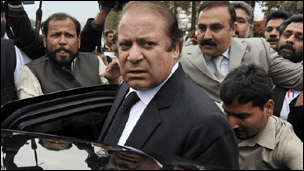
Looks Zardari has survived another attack. This time it seemed to be fatal one. There must have been some collateral damage. Soon we may know its extent. But no one should be complacent. This will by no means be the last attack against the president & the democratic system by his haters & anti democracy forces. They might have already put the things in process for their next move.
Search This Blog
Sunday, December 11, 2011
Zardari Survives? But At What Cost? How Long?
Friday, December 9, 2011
PPP Needs To Re-evaluate It's Policies
Zardari may return, with broken wings, powerless & as a mere figurehead like Fazal Elahi Chaudhry or Rafiq Tarar; he may even resign as party co-chairperson or become inactive in that position & let Bilawal become more active. But will that be a solution to the problems Pakistan or PPP face? I don't think so. Much more needs to be done. Some heads have to roll & some basic re-evaluation of PPP policies have to take place. People like Faryal, Babar, Rehman and many more must go. People like Aitzaz & Rabbani should be brought in. Corruption, nepotism must be checked.
Most important is to go back to Benazir Bhutto's policies and stand since her meeting with MNS in Jeddah & later signing of CoD in London, UK. Their written & unwritten agreements must be followed. PPP must change its attitude towards judiciary. It should distance itself from pro-Musharraf parties & try to work with PML-N. It is the need of the hour that PPP & PML-N join hands at this moment to foil the conspiracies hatched by anti-democracy forces. (8 December, 2011)
Most analysts agree that the real Pakistai rulers since last 60 plus years are now fed up with Zardari. But they are not willing to put Nawaz Sharif in the driving seat again either. Why then MNS has taken upon him to dislodge Zardari government through Supreme Court. Does he have any false assurances or any illusions or is he unwittingly paving the way for military establishment’s hand picked man, Imran Khan to come to power? (7 December, 2011)
Presence of Osama bin Laden next door to Pakistan's premier military academy in Abbottabad was a smoking gun against military establishment. They kept lying. No accountability. When elected PMs wanted peace with India, they were either overthrown or sabotaged with conspiracies like the abortive Kargil offensive. When an elected president talked of an agreement on no-first use of atomic bomb & industrial zone on the borders with India, they planned terrorist attack in Mumbai. They have been defeated in all the wars with India but have conquered own country FOUR times & are eating away most of country's budget & have become biggest industrial & commercial enterprise in the country.
They killed, raped & injured hundreds of thousands of people in Bengal yesterday & are repeating the same in Balochistan today, no questions asked. Murder of Bhuttos, Bugti & several more is on their hands.
Thousands have sacrificed for an end to military role but their sacrifices seem to have gone in vain as they again are staging comeback using anti-American bogey today. What a waste! (30 November, 20110
Labels:
Abbottabad,
Babar,
Benazir Bhutto,
Bilawal,
Faryal,
Indus Herald,
ISI,
Jeddah,
Nawaz,
Osama,
Pakistan,
PML-N,
PPP,
Rabbani,
Rehman,
smoking gun,
Supreme Court,
Zardari
Friday, December 2, 2011
27th December: Get Ready For Another Zardari-Rehman Malik Drama
27th December is almost upon us. Get ready for another Zardari-Rehman Malik drama about “catching” & “punishing” the “killers of Shaheed BB”. It is about 4 years since the PPP chairperson was assassinated in Pak Army town, Rawalpindi. Her party, led by her widower & son, has been in power for 3 years & 9 months since then. First they delayed any meaningful investigation in the name of UN probe. When UN commission submitted its report, they rejected it & refused to act on it. Then they said they would hold their own inquiry. Now their hand-maiden report is ready since more than a year but they won’t publish or disclose it in full. Last year, they delayed the arrival of the 'son' in Garhi Khuda Bux for a day & issued an statement afterwards that since he couldn't attend the party CEC meeting, the report could not be announced on BB’s 3rd death anniversary.
In between, they have not shown any seriousness to go after the killers. Instead they have been seen as an impediment in the case being heard in a Rawalpindi court. They have transferred, harassed or offered no cooperation to the public prosecutor & the judge. They haven’t done a thing to oblige the court order to bring ex-military dictator Musharraf to the country to appear before the court, as he is the main accused. What new drama this year? Wait & see! 27th December is not too far away.
Worrying About "Memogate"? How about "Veenagate" Now?
So you have been worrying too much about the so-called memogate? How about "Veenagate" now? Controversy-prone Pakistani actress, Veena Malik is in the eye of another storm as an Indian fashion magazine, FHM, has published an almost nude picture of her on its cover. What may be more disturbing for the pseudo patriotic elements in Pakistan, including the sleuths, fundos, IK, MNS, Choudhry Iftikhar & others, is an unpardonable sin of sporting a tattoo on her arm, reading ISI!
VM says the photos are 'morphed'. FHM says pictures are genuine & they have proof including a video of the shoot & emails from VM.
So will the ultra patriots go to Supreme court now against this actress blaming her of defaming the country? And more sinful at that, doing so in the "enemy" country? Or will Choudhry Iftikhar take a suo mottu notice? God may be with this poor actress & save her from vultures in "Pak Vatan".
Labels:
Choudgry Iftikhar,
FHM,
IK,
India,
ISI,
memogate,
MNS,
Pakistan,
Veena Malik,
Veenagate
Memogate & Mian Nawaz Sharif
![]() |
| MNS in black coat & tie, ready to plead in Memogate case before the SC |
Memogate is certainly somebody else's war. Mian Nawaz Sharif should not have got involved in it. He might have been competing with Imran Khan, thinking that if he didn't, Imran Khan might take it to the Supreme Court & score few more runs in the match to take Punjab Trophy. Is that what politics has come to in Pakistan? No, but that is how politics has always been in Pakistan! Very disappointing!
Friday, October 28, 2011
Begum Bhutto remembered: By Kamran Shafi
When I see the carping on Twitter, and various blogs and discussion boards and what have you, complaining about the holiday to mark the passing of Begum Nusrat Bhutto; or about the government flying journalists to Larkana to cover her funeral, I am further convinced that a whole lot of young Pakistanis simply do not know this country’s tortured history.
Which is not their fault: the mass (Urdu) media, both print and electronic, instead of periodically reminding the nation of its real heroes and heroines (and their tribulations at the hands of army dictators), is much more taken up with trashing our politicians, the pet hate of the Deep State.
You might ask why I introduced the term ‘tribulation’ so early in this piece. Simply because, dear reader, Begum Nusrat Bhutto’s life after the assassination of her husband was, for many many years, one long and painful ordeal, and yes, one of great tribulation.
It began with the arrest of her husband, the former (for Zia had already carried out his coup against the elected government) elected prime minister, and president of Pakistan, on what were quite apparently trumped up charges; his release on bail; and his rearrest under Martial Law Regulations after tens of thousands of people turned out in Lahore to welcome him when he visited that city after his release.
Then came the murder trial in the Lahore High Court under the Chief ‘Justice’ himself, the malevolent Maulvi Mushtaq, an avowed and declared Bhutto enemy who refused to recuse himself even after ZAB said he had no faith in him. If the conduct of the trial was disgusting for outside observers like I, how painful must it have been for Begum Bhutto to daily see needless indignities heaped upon her husband?
One little story to do with the dastardliness of Maulvi Mushtaq. One day, as ZAB was brought out of Kot Lakhpat Jail to the police van that transported him to court, he saw that the chair he used to sit on in the back of the van had been removed. When he asked why, he was told there were ‘orders’ that he should sit on the wooden benches along the sides of the van.
ZAB refused and said in that case he would not attend court that day. Telephone calls flew back and forth, and the ‘orders’ were withdrawn. When the court assembled, Maulvi told ZAB to stand up and to keep standing for that day’s proceedings. When Bhutto protested, saying he should not be treated that way for he was, after all, a former president and prime minister, Maulvi flew into a rage and reportedly shouted: “You are a criminal; you will sit wherever you are told to sit… one more word out of you and I will have you whipped in jail!”
While he was being treated thus, his wife and daughter were also at the receiving end of the dictator’s malice. On December 16, 1977, a mere five months after her husband was removed from the elected office of prime minister, Begum Bhutto and her daughter, the much missed, much lamented Benazir, were lathi-charged by the police while they were watching the England-Pakistan Test match at the Gaddafi Stadium in Lahore just because the crowd raised ‘Jeay Bhutto’ slogans. Photographs of Begum Bhutto, her forehead dripping with blood, have appeared widely over the internet over the past few days.
The scandalous trial went on: Maulvi’s court sentencing ZAB to death and the Supreme Court rejecting his appeal, with four Punjabi judges convicting and three non-Punjabi judges acquitting him. Despite this split verdict and against all judicial precedence, ZAB was hanged in Rawalpindi Jail on April 4, 1979. I might add that whilst I am a Punjabi myself, it is important to speak up about the ethnic make-up of the bench.
Zia did many a monstrous thing, but one of the most monstrous was when he refused to let Begum Nusrat Bhutto and Benazir attend the last rites of their husband and father! How ‘pious’ this charlatan was can be judged from just this one act. Which Muslim will keep a person’s family from burying their own? Pakistan’s army dictators — the Commando did the same with Nawaz and Shahbaz Sharif when their dear father died — and, of course, the wild hordes who beat Muammar Qaddafi to death.
The graceful Begum Bhutto took all that was thrown at her with great stoicism and courage, and in due course started an agitation which led to the Movement for the Restoration of Democracy that showed the world that the tyrant was vulnerable. If Begum Nusrat Bhutto has been named the ‘Mother of Democracy in Pakistan’, she fully deserves the title.
I end with a personal anecdote: in the spring of 1988, after I had accepted Prime Minister Benazir Bhutto’s offer to work for the government as public information officer (PIO), Begum Bhutto sent for me. She recounted how she and ZAB knew my father and family and asked if I would come work for her on her staff. While I was delighted, I said, “Begum Sahiba, thank you, but the prime minister has just yesterday asked me to work for the government as PIO”. “Really” she said, and then smiled so very warmly. “Well, at least you will be with us”.
And then she started to cry. “They have been so horrible to us… you cannot imagine what they have done to us… even accusing Zulfikar of buying a personal chandelier with government money… but I have the receipts… you know, he would pay even the smallest personal bill in the PM’s House by cheque… and when I said why he was bothering writing a cheque when I had money in my bag, he would say, ‘Nusrat you don’t know them; they will say and do anything to destroy me and my name… I must have records…’”.
I am exhausted dear reader… more another time… may the Almighty give strength to those who loved her.
RIP, Begum Sahiba.
Courtesy: daily The Express Tribune, October 28th, 2011.
Which is not their fault: the mass (Urdu) media, both print and electronic, instead of periodically reminding the nation of its real heroes and heroines (and their tribulations at the hands of army dictators), is much more taken up with trashing our politicians, the pet hate of the Deep State.
You might ask why I introduced the term ‘tribulation’ so early in this piece. Simply because, dear reader, Begum Nusrat Bhutto’s life after the assassination of her husband was, for many many years, one long and painful ordeal, and yes, one of great tribulation.
It began with the arrest of her husband, the former (for Zia had already carried out his coup against the elected government) elected prime minister, and president of Pakistan, on what were quite apparently trumped up charges; his release on bail; and his rearrest under Martial Law Regulations after tens of thousands of people turned out in Lahore to welcome him when he visited that city after his release.
Then came the murder trial in the Lahore High Court under the Chief ‘Justice’ himself, the malevolent Maulvi Mushtaq, an avowed and declared Bhutto enemy who refused to recuse himself even after ZAB said he had no faith in him. If the conduct of the trial was disgusting for outside observers like I, how painful must it have been for Begum Bhutto to daily see needless indignities heaped upon her husband?
One little story to do with the dastardliness of Maulvi Mushtaq. One day, as ZAB was brought out of Kot Lakhpat Jail to the police van that transported him to court, he saw that the chair he used to sit on in the back of the van had been removed. When he asked why, he was told there were ‘orders’ that he should sit on the wooden benches along the sides of the van.
ZAB refused and said in that case he would not attend court that day. Telephone calls flew back and forth, and the ‘orders’ were withdrawn. When the court assembled, Maulvi told ZAB to stand up and to keep standing for that day’s proceedings. When Bhutto protested, saying he should not be treated that way for he was, after all, a former president and prime minister, Maulvi flew into a rage and reportedly shouted: “You are a criminal; you will sit wherever you are told to sit… one more word out of you and I will have you whipped in jail!”
While he was being treated thus, his wife and daughter were also at the receiving end of the dictator’s malice. On December 16, 1977, a mere five months after her husband was removed from the elected office of prime minister, Begum Bhutto and her daughter, the much missed, much lamented Benazir, were lathi-charged by the police while they were watching the England-Pakistan Test match at the Gaddafi Stadium in Lahore just because the crowd raised ‘Jeay Bhutto’ slogans. Photographs of Begum Bhutto, her forehead dripping with blood, have appeared widely over the internet over the past few days.
The scandalous trial went on: Maulvi’s court sentencing ZAB to death and the Supreme Court rejecting his appeal, with four Punjabi judges convicting and three non-Punjabi judges acquitting him. Despite this split verdict and against all judicial precedence, ZAB was hanged in Rawalpindi Jail on April 4, 1979. I might add that whilst I am a Punjabi myself, it is important to speak up about the ethnic make-up of the bench.
Zia did many a monstrous thing, but one of the most monstrous was when he refused to let Begum Nusrat Bhutto and Benazir attend the last rites of their husband and father! How ‘pious’ this charlatan was can be judged from just this one act. Which Muslim will keep a person’s family from burying their own? Pakistan’s army dictators — the Commando did the same with Nawaz and Shahbaz Sharif when their dear father died — and, of course, the wild hordes who beat Muammar Qaddafi to death.
The graceful Begum Bhutto took all that was thrown at her with great stoicism and courage, and in due course started an agitation which led to the Movement for the Restoration of Democracy that showed the world that the tyrant was vulnerable. If Begum Nusrat Bhutto has been named the ‘Mother of Democracy in Pakistan’, she fully deserves the title.
I end with a personal anecdote: in the spring of 1988, after I had accepted Prime Minister Benazir Bhutto’s offer to work for the government as public information officer (PIO), Begum Bhutto sent for me. She recounted how she and ZAB knew my father and family and asked if I would come work for her on her staff. While I was delighted, I said, “Begum Sahiba, thank you, but the prime minister has just yesterday asked me to work for the government as PIO”. “Really” she said, and then smiled so very warmly. “Well, at least you will be with us”.
And then she started to cry. “They have been so horrible to us… you cannot imagine what they have done to us… even accusing Zulfikar of buying a personal chandelier with government money… but I have the receipts… you know, he would pay even the smallest personal bill in the PM’s House by cheque… and when I said why he was bothering writing a cheque when I had money in my bag, he would say, ‘Nusrat you don’t know them; they will say and do anything to destroy me and my name… I must have records…’”.
I am exhausted dear reader… more another time… may the Almighty give strength to those who loved her.
RIP, Begum Sahiba.
| The writer is a columnist, a former major of the Pakistan Army, and served as press secretary to Benazir Bhutto |
Courtesy: daily The Express Tribune, October 28th, 2011.
Wednesday, October 12, 2011
Benazir Bhutto’s Alleged Murder Plotter Joins PML-N, Shaikh Rasheed to Follow
By Aijaz Ahmed
Islamabad: Pakistan Muslim League (N) proudly calls itself a principled party and claims it is against 'lotacracy' and that it always abides by the Charter of Democracy. It also uses the name of Benazir Bhutto whenever it’s leaders want the government to go on the back foot. However its double standards have been exposed as the same "principled" party has allowed an alleged plotter of Benazir Bhutto's murder and a close associate of military dictator Musharraf and the Choudhris of Gujrat to join PML-N.
It may be recalled here that Benazir Bhutto had sent an email in 2007 to her lobbyist in Washington, DC and a family friend, Mark Siegel, containing four names who according to her were plotting her murder according g to her own information. The then Director General IB Brigadier (retd) Ijaz Shah’s name was one of the four suspects nominated by BB herself.
![]() |
| Former IB chief, Brig. Ret. Ijaz Shah |
BB’s suspicion of her murder plot was not baseless. She was indeed brutally martyred at Liaquat Bagh in Rawalpindi on 27th December 2007. Brigadier Ijaz shortly after the general elections in 2008 ran away from Pakistan and settled in Australia with the blessings of the man at the helm of affairs at that time and he was no other than Musharraf. As Ijaz Shah was also known as a close friend of PML-N’s arch rivals, the Choudhris of Gujrat, the party had started an aggressive campaign when PPP joined hands with the Q league. It had blamed PPP of selling out the murder of BB “Shaheed”.
The PML-N had vowed to take revenge from the murderers if and when it formed a government in the center. But all the claims, love and respect for BB has proved to be false and a mere political stunt as Ijaz Shah who returned to Lahore few weeks back after a secret settlement with Punjab government has formally joined PML-N few days back and signed the membership form of the party from Nankana Sahib, suburban town of Sheikhupura near Lahore and the place of birth of Guru Nanak, the founder of Sikh religion and a great fighter against state repression.
No word of sorry has been tendered by the “principled” PML-N leadership to the followers of BB most of whom had started believing in Nawaz Sharif after losing their faith in Asif Zardari. The reason given by PML-N for taking such people and members of Q league in the party ranks is most interesting. Senator Pervez Rasheed while giving his reaction to a question about the talks with Q league responded positively and uttered that “we will talk with everybody willing to join us against Zardari Raj”. ‘We are in contact with PML-Q and will accept anybody except the Choudhris of Gujrat. We want to isolate them in politics and will go to any extent’, he added.
The “principled” PML-N now seems to follow the policy of lotacracy which it talked against so much at one time to stop it’s arch rival PPP from gaining majority in the Senate in March next year. Sumera Malik, a close aide of Musharraf and a cause of confrontation between Chief Justice Iftikhar Choudhry and General Musharraf has now become very close to Mian Sahib. She is going to join PML-N despite being a member from PML-Q. She earlier tried to join PPP, but her relationship with Farooq Leghari did not prove very helpful.
Labels:
Benazir Bhutto,
Brigadier Ijaz Shah,
GHQ,
IB,
Indus Herald,
Islamabad,
Lahore,
lotacracy,
Mark Siegel,
Musharraf,
Nawaz Sharif,
Pakistan,
PML-N,
PML-Q,
PPP,
Rawalpindi,
Sheikh Rashid
Tuesday, October 11, 2011
Split in Sindh PPP Imminent; President Offers Aitzaz An Important Position, May Play Prominent Role in Future; Nawaz-Mirza under Pressure for Alliance; Fahmida Mirza Offers to Resign
Aitzaz May Play Prominent Role in Future; How Fasih Bokhari Was Nominated as Chairman NAB?
By Aijaz Ahmed
Islamabad: There seldom comes a cooling off interval in Pakistani politics - at least not these days. With every passing moment, the temperature gets higher and the hectic moves and counter moves by the stakeholders create more and more confusion. Amidst all that, the moves by one of the players, Zulfikar Mirza may soon result in split within his own party.
On his return from Malaysia, Zulfikar Mirza dropped another bombshell; he addressed a press conference along with the leaders of the Peoples Amn Committee and announced that following in the footsteps of Imran Khan, he would carry three suitcases to London, UK, filled with evidence against Altaf Hussain of MQM. The statement of Mirza created another storm in the troubled city of Karachi and prompted MQM demands for his arrest. The rampant political crisis is destined to lead towards a final showdown within the PPP ranks as well as between the PPP and its love-hate partner the MQM.
A group of PPP dissidents from Sindh is getting united with a resolve to fight against any effort for passing the proposed Local Government Ordinance, which was first introduced by military dictator Musharraf and then reintroduced by Babar Awan known as Mr. Tughral in the political circles of Islamabad.
The move is not only to oppose the local government ordinance bill, but the built in opposition to the government-MQM alliance is also coming to the fore. The group emerging around Mirza in Sindh will ultimately gain strength, and the people in the province having sympathies with PPP will by and large go with Mirza team, says a PPP leader from the political team of the president, Zardari.
The central leadership of the party is trying its best to control the damage caused by Mirza, but for the first time in the history of the party, it appears that all the efforts by the leadership are going in vain as dissent in the party is visibly increasing.
The game does not end there; rather another innings of the long and tiring game of politics is being started again, and the umpires of the game have become, as always, the main players of the innings now. There are clear indications that the behind-the-scene players who ‘encouraged’ Mirza to go up in the arms to such an extent where he put his relationship with the president at stake are trying to bring Mirza and Nawaz Sharif closer on some point of mutual interests and that is the opposition of MQM and elimination of corruption, sources in the power circle of Islamabad have revealed.
The anti Zardari policy of Nawaz Sharif and his PML-N is the main cause of concern for Mirza, the sources said, adding that the players are trying to evolve a mutually acceptable position in this regard.
The people and the forces who matter are hectically busy in hatching a deal between the two, but hard line taken by Mirza has been an impediment so far, sources claimed. Mirza does not want to take blame of stabbing in the back his closest friend and mentor, thus he has put some hard conditions. Mirza wants Nawaz Sharif to give up his go Zardari go policy, sources maintained. Mirza also wants Nawaz Sharif and the wheelers behind the move to agree to a mutually acceptable guarantee that his friend will be allowed to complete his present tenure and that if he gets elected as president again, he will be allowed to complete that tenure as well.
On the other hand interesting political developments are taking place in the federal capital. Khursheed Shah, whose residence was used last night by PPP dissidents in Karachi to host dinner for Mirza was enjoying president’s hospitality and was discussing matters related to Sindh. Earlier Dr. Fahmida Mirza, wife of Zulfikar Mirza and Speaker of the National Assembly had offered resignation from her office citing MQM’s nasty behavior, but President strongly rejected her offer, sources maintained. He asked madam speaker to continue as she happens to be the first woman speaker of Asia.
President not only confined himself to reject the resignation of the speaker, but also showed some positive gestures for Mirza. Rehman Malik and Babar Awan have been kept away from the presidency since last two days. Both Awan and Rehman Malik were not invited to the recent PPP Core Committee at Aiwan e Saddar.
It is also revealed that in the last three and half years there was no single incident where president did not consult with Mr. Awan on some important legal matters. It was after the new blast of Mr. Mirza that President did not take a legal opinion from Mr. Awan. Rather Farooq H Naik was consulted on legal and constitutional implication of Supreme Court decision on Karachi.
Another political development was dinner hosted for Aitzaz Ahsan by President after almost six months. Bushra Aitzaz was present in the dinner. Aitzaz was offered an important position but he declined. He is said to be interested to become next Chairman of Senate. It was Aitzaz Ahsan who suggested to the president to appoint Fasih Bokhari as Chairman NAB and the president within no time accepted his suggestion that gives indication of improving relations between the President and Mr. Aitzaz and people may see the legal wizard playing vital role in near future.
Sunday, October 2, 2011
G. M. Syed: Sindh's Tolerant Past & Sufism; Traitor Saves the Day by Nadeem F. Paracha
![]() | |||
| G. M. Syed (January 17, 1904 - April 25, 1995) |
Yes, but whereas we are told that this is due to Sindh’s tolerant, Sufi past, very few remember that this historical narrative (about Sindhi history and culture) was not exactly constructed hundreds of years ago. Instead, this narrative, that today has kept much of Sindh at bay from puritan forms of the faith, was actually built by a controversial man who was also labelled by the establishment and the religious parties as a ‘traitor’. His name was G M Syed.
In the late 1950s, Syed was a leading part of the left-wing National Awami Party (NAP), a political expression of Sindhi, Baloch, Pashtun and Bengali nationalists opposed to the conservative West Pakistan dominated ruling elite. NAP was banned by the Ayub Khan dictatorship in 1959, and till its revival in 1962, Syed decided to lead a cultural Sindhi nationalist movement. In 1966 when he was released from jail, he did not rejoin NAP and instead formed a cultural organisation called Bazm-i-Sufia-i-Sindh.
The Bazm also boasted some other famous Sindhi scholars, who set out to create an elaborate historical, intellectual and political narrative of Sindhi culture and history, presenting it as distinct, yet based on pluralistic values. This definition ran counter to what had officially been propagated by Pakistan’s military-civilian elite as ‘Pakistani culture’.
The Bazm also tried to prove that the Islam practised by Sindhis was very different from the version that was being ‘enforced by the Pakistani state and the ruling elite’. Bazm scholars maintained that Sindh had always been the land of mystics (Sufis) and Sindhis have had a history of being extremely tolerant of Hindus and other faiths. The Bazm and Syed were clearly proposing that Sindh and the Sindhis could not be integrated by the state of Pakistan due to the stark cultural differences that they had with what became known as ‘Pakistan ideology’ (a term first used by the Jamat-i-Islami in 1967).
The Bazm went a step further when it published a controversial study in late 1966 which stated that Raja Dahir (the 8th century Hindu ruler of pre-Islamic Sindh) was actually a hero to many Sindhis and that Muhammad bin Qasim (the Arab Muslim commander who defeated Dahir and conquered Sindh) was regarded as a usurper. The ruling establishment (being dominated at the time by the Ayub led military regime) and the religious parties at once denounced Syed and the Bazm as traitors.
But this did not stop Syed. He asked the Bazm to create a student wing, the Sindhi Students Cultural Council, that held seminars and lectures across Sindh and imparted the Bazm’s radically revisionist history of Sindh amongst young Sindhis. At the start of the students and workers movement against the Ayub dictatorship in late 1967, the Bazm become part of the Sindh United Front (SUF) — an organisation of Sindhi nationalists that wanted to step in and play their role in the movement. Syed wanted to use the chaos resulting from the movement to bid for Sindh’s separation from Pakistan.
But since by 1968 the movement was revolving around Zulfikar Ali Bhutto (a Sindhi) and his Pakistan People’s Party, G M Syed advised the SUF to incorporate in its ranks those who were not only against Ayub but also against Bhutto. Syed feared that Bhutto would become the biggest hindrance to Sindhi separatism. He was right. Though the Bazm withered away in the early 1970s, its works and ideas have continued to inspire various Sindhi nationalist organisations and the youth.
It is ironic that from 1972 under Bhutto’s rule, his regime heavily borrowed the more moderate aspects of Syed and the Bazm’s Sindhi nationalist thesis and it was during Bhutto’s regime (1972-77) that Sindh began being (officially) called the ‘land of Sufis.’
In another twist of irony, not only is it still called that in Pakistan’s history text books, but is accepted as that by none other than Altaf Hussain’s Mohajir-centric, Muttahida Qaumi Movement (MQM) and many Punjabi politicians. Also, it is this (once denounced) narrative and its widespread proliferation across the decades in Sindh that has kept the province relatively safe from the kind of puritan radicalisation that Punjab and Khyber Pakhtunkha have been witnessing ever since the Zia dictatorship, from the 1980s onwards.
One is not sure what the Sindhis thought about Dahir or Qasim before the 1960s, but it is true that ever since the 1970s, Muhammad Bin Qasim is not so hot as a historical entity in Sindh as he is elsewhere in Pakistan — a fact that, for example, greatly tormented the pro-Jamat-i-Islami ‘historical novelist’ Naseem Hijazi, who had spend a good part of his career turning various Arab commanders into pious supermen.
![]() | |||
| Author |
APC: civil façade of foreign policy — Farhat Taj
Both Nawaz Sharif and Mahmood Achakzai deserve credit for making their views heard to the APC participants dominated by pro-establishment political parties. Their voices, although not part of the ‘unanimous’ resolution, were echoed by the media
Since the recent attack on the US embassy in Kabul by the Haqqani network Taliban, Pakistan came under immense US pressure, including veiled threats of attack, for its links with the Haqqani Taliban with bases in Pakistan. Pakistan’s military, which runs the country’s foreign policy on Afghanistan, rejected all the statements from the US but still needed the country’s civil political leadership to stand by it to offset US pressure. Hence an All-Parties Conference (APC) was held by the PPP-led government to create a façade of civil ownership of the military-run policy in Afghanistan.
The text of the 13-point ‘unanimously’ approved resolution of all parties’ heads seems hardly anything more than a script from the ISPR. The text is mostly rhetorical without referring to the terror sanctuaries in Pakistan pointed out not only by the US but many people within Pakistan. The text, as expected, rejects US allegations about the ISI’s links with the Haqqani network.
A striking statement in the text is this: “Pakistan must initiate dialogue with a view to negotiating peace with our own people in the tribal areas [FATA] and a proper mechanism for this be put in place.” This is also the oft-repeated position of Pakistan Tehreek-e-Insaf (PTI) leader Imran Khan, who always projects the Taliban as synonymous with the Pakhtuns. What is the justification of giving such a prominent mention in the resolution to the position of the unrepresentative PTI while totally ignoring the scepticism of the twice elected prime minster of Pakistan and leader of an elected PML-N, Mr Nawaz Sharif? Mr Sharif asked the military leaders present in the conference that there must be a ‘reason’ why the whole world is holding Pakistan responsible for terrorism, a direct reference to the generals’ links with terrorist organisations.
Moreover, it is immensely surprising that the PTI’s position was recorded in the resolution but there is nothing in the text that reflects the view of Mahmood Khan Achakzai, leader of the Pakhtun nationalist party, Pakhtunkhwa Milli Awami Party (PkMAP), who reportedly told the ISI chief at the APC that “there will be peace in Afghanistan within a month, provided the ISI stopped exporting terrorism into that country”. PkMAP, unlike PTI, has a representation in the Senate of Pakistan and has a longstanding firmly held position whereby it asserts that the ISI is responsible for terrorism in Afghanistan and FATA. It is remarkable to note that the ‘unanimously’ passed resolution does not accommodate the point of view of this party that has lost several political workers, who were anti-Taliban, in targeted killings in FATA. The party leaders hold the ISI responsible for their killings.
Both Nawaz Sharif and Mahmood Achakzai deserve credit for making their views heard to the APC participants dominated by pro-establishment political parties. Their voices, although not part of the ‘unanimous’ resolution, were echoed by the media, putting a question mark on the ‘unanimous’ status of the resolution.
A strange position not concurring with the longstanding position on Pakistan’s Afghan policy of the other Pakhtun nationalist party, the Awami National Party (ANP), was adopted by its leader, Asfandyar Wali, in the APC. It is pertinent to mention that the ANP issued an official statement on September 23, 2011 in the context of the growing tension between Pakistan and the US. The statement, while expressing concerns over US threats to Pakistan, “calls for an all out effort by the government (of Pakistan) to root out such (terrorist) groups, their supply lines and infrastructure (on Pakistani soil)”. The statement declares such effort as “an inescapable and urgent need of evolving a clear strategy for dealing with terror outfits (in Pakistan)”. The statement was totally ignored by the Pakistan media in line with its track record of suppressing the Pakhtun nationalist standpoint.
A few days later, ANP’s provincial leader, Afrasiab Khattak, expressed a similar view as in the official statement in a TV interview, also referred to in Dr Taqi’s column, ‘US-Pakistan relations: a rocky road ahead’ (Daily Times, September 29, 2011). By taking almost a U-turn a few days later the ANP-led Khyber Pakhtunkhwa Assembly passed a unanimous resolution condemning US threats without any reference to the terror sanctuaries, including the Haqqani network, in Pakistan. A couple of days later, Asfandyar Wali Khan participated in the APC without making his party’s longstanding position on the Afghan policy heard and quietly toeing the establishment’s line.
This leaves one to wonder what the real position of the ANP is on the current US-Pakistan tension on the Haqqani Taliban. The ANP, which has sacrificed the blood of hundreds of its workers for the party’s anti-Taliban stance, must show the courage to publicly explain which of the two texts — the APC resolution or the party official statement — really represent the real party position.
In the current political scenario in Pakistan, it looks like the ANP position is oscillating between blackmailing the military establishment of Pakistan with the party’s nationalist position on Afghanistan and collaboration with the establishment provided it accommodated the party in the ruling alliance of Pakistan as a junior partner. Even under the leadership of Begum Nasim Wali Khan — many believe the party organisation suffered under her leadership — the ANP never compromised in publicly asserting its longstanding position on the Afghan policy of Pakistan, the position that asserts that the establishment’s strategic depth policy is responsible for the violence and instability in Afghanistan. The ANP today seem to be suffering from such a compromised leadership that the party has never seen in the past.
Notwithstanding Achakzai’s straightforward comment to the ISI chief, both he and Asfandyar Wali have to explain how they can accept the point in the resolution mentioned earlier in this column. Do the two leaders not know that the militants in FATA are the Punjabi Taliban and international terrorists linked with al Qaeda, who have committed atrocities on the tribal people, including the tribal political workers of the ANP and PkMAP? Do they not know that the ISI, not the tribal people, brought these terrorists to FATA? Do they not know that local communities in FATA view the local Pakhtun Taliban, a fringe element of the tribal society, as murderers and anti-social elements who need to face justice?
The two nationalist leaders should have boycotted the APC for inclusion of such a misguiding statement in the resolution. One must appreciate the Baloch nationalist leaders for boycotting the APC in response to the state crimes against the Baloch people. Alas the Pakhtun leadership is too compromised to take such a courageous stance on their people.
The writer is the author of Taliban and Anti-Taliban
Courtesy: daily Times
Since the recent attack on the US embassy in Kabul by the Haqqani network Taliban, Pakistan came under immense US pressure, including veiled threats of attack, for its links with the Haqqani Taliban with bases in Pakistan. Pakistan’s military, which runs the country’s foreign policy on Afghanistan, rejected all the statements from the US but still needed the country’s civil political leadership to stand by it to offset US pressure. Hence an All-Parties Conference (APC) was held by the PPP-led government to create a façade of civil ownership of the military-run policy in Afghanistan.
The text of the 13-point ‘unanimously’ approved resolution of all parties’ heads seems hardly anything more than a script from the ISPR. The text is mostly rhetorical without referring to the terror sanctuaries in Pakistan pointed out not only by the US but many people within Pakistan. The text, as expected, rejects US allegations about the ISI’s links with the Haqqani network.
A striking statement in the text is this: “Pakistan must initiate dialogue with a view to negotiating peace with our own people in the tribal areas [FATA] and a proper mechanism for this be put in place.” This is also the oft-repeated position of Pakistan Tehreek-e-Insaf (PTI) leader Imran Khan, who always projects the Taliban as synonymous with the Pakhtuns. What is the justification of giving such a prominent mention in the resolution to the position of the unrepresentative PTI while totally ignoring the scepticism of the twice elected prime minster of Pakistan and leader of an elected PML-N, Mr Nawaz Sharif? Mr Sharif asked the military leaders present in the conference that there must be a ‘reason’ why the whole world is holding Pakistan responsible for terrorism, a direct reference to the generals’ links with terrorist organisations.
Moreover, it is immensely surprising that the PTI’s position was recorded in the resolution but there is nothing in the text that reflects the view of Mahmood Khan Achakzai, leader of the Pakhtun nationalist party, Pakhtunkhwa Milli Awami Party (PkMAP), who reportedly told the ISI chief at the APC that “there will be peace in Afghanistan within a month, provided the ISI stopped exporting terrorism into that country”. PkMAP, unlike PTI, has a representation in the Senate of Pakistan and has a longstanding firmly held position whereby it asserts that the ISI is responsible for terrorism in Afghanistan and FATA. It is remarkable to note that the ‘unanimously’ passed resolution does not accommodate the point of view of this party that has lost several political workers, who were anti-Taliban, in targeted killings in FATA. The party leaders hold the ISI responsible for their killings.
Both Nawaz Sharif and Mahmood Achakzai deserve credit for making their views heard to the APC participants dominated by pro-establishment political parties. Their voices, although not part of the ‘unanimous’ resolution, were echoed by the media, putting a question mark on the ‘unanimous’ status of the resolution.
A strange position not concurring with the longstanding position on Pakistan’s Afghan policy of the other Pakhtun nationalist party, the Awami National Party (ANP), was adopted by its leader, Asfandyar Wali, in the APC. It is pertinent to mention that the ANP issued an official statement on September 23, 2011 in the context of the growing tension between Pakistan and the US. The statement, while expressing concerns over US threats to Pakistan, “calls for an all out effort by the government (of Pakistan) to root out such (terrorist) groups, their supply lines and infrastructure (on Pakistani soil)”. The statement declares such effort as “an inescapable and urgent need of evolving a clear strategy for dealing with terror outfits (in Pakistan)”. The statement was totally ignored by the Pakistan media in line with its track record of suppressing the Pakhtun nationalist standpoint.
A few days later, ANP’s provincial leader, Afrasiab Khattak, expressed a similar view as in the official statement in a TV interview, also referred to in Dr Taqi’s column, ‘US-Pakistan relations: a rocky road ahead’ (Daily Times, September 29, 2011). By taking almost a U-turn a few days later the ANP-led Khyber Pakhtunkhwa Assembly passed a unanimous resolution condemning US threats without any reference to the terror sanctuaries, including the Haqqani network, in Pakistan. A couple of days later, Asfandyar Wali Khan participated in the APC without making his party’s longstanding position on the Afghan policy heard and quietly toeing the establishment’s line.
This leaves one to wonder what the real position of the ANP is on the current US-Pakistan tension on the Haqqani Taliban. The ANP, which has sacrificed the blood of hundreds of its workers for the party’s anti-Taliban stance, must show the courage to publicly explain which of the two texts — the APC resolution or the party official statement — really represent the real party position.
In the current political scenario in Pakistan, it looks like the ANP position is oscillating between blackmailing the military establishment of Pakistan with the party’s nationalist position on Afghanistan and collaboration with the establishment provided it accommodated the party in the ruling alliance of Pakistan as a junior partner. Even under the leadership of Begum Nasim Wali Khan — many believe the party organisation suffered under her leadership — the ANP never compromised in publicly asserting its longstanding position on the Afghan policy of Pakistan, the position that asserts that the establishment’s strategic depth policy is responsible for the violence and instability in Afghanistan. The ANP today seem to be suffering from such a compromised leadership that the party has never seen in the past.
Notwithstanding Achakzai’s straightforward comment to the ISI chief, both he and Asfandyar Wali have to explain how they can accept the point in the resolution mentioned earlier in this column. Do the two leaders not know that the militants in FATA are the Punjabi Taliban and international terrorists linked with al Qaeda, who have committed atrocities on the tribal people, including the tribal political workers of the ANP and PkMAP? Do they not know that the ISI, not the tribal people, brought these terrorists to FATA? Do they not know that local communities in FATA view the local Pakhtun Taliban, a fringe element of the tribal society, as murderers and anti-social elements who need to face justice?
The two nationalist leaders should have boycotted the APC for inclusion of such a misguiding statement in the resolution. One must appreciate the Baloch nationalist leaders for boycotting the APC in response to the state crimes against the Baloch people. Alas the Pakhtun leadership is too compromised to take such a courageous stance on their people.
The writer is the author of Taliban and Anti-Taliban
Courtesy: daily Times
Friday, September 23, 2011
Another US-Saudi Intervention in Pakistan; Threatens the Civilian Setup, Coerces Military Establishment
Pakistan is an unfortunate country as it has not only been prone to various calamities and disasters, but also throughout its history, it has remained battlefield for the international players. It is also a country that always remained under pressure from Saudi Arabia in the name of Muslim Ummah and China in the name of the evergreen friendship with heavy cost to Pakistan in the terms of industry, economy and trade of certain goods. However, it happens to be the biggest victim of US-Saudi nexus, which seems active once again and no wonder to dislodge political dispensation as in the past.
By Aijaz Ahmed
![]() |
| Former Afghanistan president, Burhanuddin Rabbani |
Islamabad: US-Pakistan relations have further strained in the aftermath of the assassination of ex-Afghanistan president Burhanuddin Rabbani as the United States has accused Pakistan of it’s involvement in the terrorist attacks inside Afghanistan and Pakistani intelligence agency, ISI’s links with Haqqani network in Pakistan.
![]() |
| US Secretary of Defense Leon Panetta & US military chief Admiral Mike Mullen |
As reported in the press, US Secretary of Defense Leon Panetta has threatened to take “operational steps” against Pakistan while the US military chief Admiral Mike Mullen has accused the ISI of it’s involvement in the attack on the US Embassy in Kabul.
The developments have paved the way for another US intervention in Pakistan’s affairs as diplomatic sources have confided to this correspondent that the US administration has threatened to dislodge the civilian setup in Pakistan. According to the sources, the US administration wants Khakis at the helm of the affairs again and wants to get rid of the political government, which is not only scared of the disciplined khakis but also the undisciplined politicians having strong voice in the parliament and media. The US administration also wants to get rid of the vibrant parliament that for the first time in the history of this country took up such critical and serious issues like the war on terror and the killing of Osama bin Laden in a secret operation by a US Navy SEALS team.
Reason behind new US moves are of the multiple nature: the US administration wants an action against Haqqani group in Afghanistan while Pakistan considers this group indispensable for peace in Afghanistan as well as in the bordering tribal belt of Pakistan. A young Haqqani was preaching peace in Mohmand Agency till few months back with the blessings of the powers that be. The role that Haqqani group can play also suggests that it is the group that can foil the designs of anti Pakistan forces, and it is the group that has significant presence and influence in Pushtoon speaking Afghanistan specially the part adjacent to the Tribal belt right from South Waziristan to Bajaur Agency and Pakistan sees the influence of the group as a tool for positive dialogue with Taliban. Perhaps this is the biggest mistake that Pakistan is making and both Army and civilians seems on one page on the issue. The Unites States considers it as a fault of the civilian administration but at the same time, it blames ISI for the quagmire.
The sources in the diplomatic circles are confident that the United States has adopted two pronged strategy: on one hand it is giving threats of waging war against Pakistan on its reported links with the Haqqani group and other Taliban groups. It has also sent a critical message through Afghanistan president Hamid Karazai, which was delivered to Prime minister Gilani today when he paid a brief visit to Kabul to condole the death of Ustad Rabbani who was killed in a suicidal attack. The message was not soft, rather it contained some hidden threat, sources maintained and that is why Prime Minister rushed to Karachi direct from Kabul to discuss with the president the possible future scenario, they confided. It is considered as the pressure and fresh moves against the elected government and the parliament.
On the other hand the US is adopting a policy to maintain a bit soft corner for the Army, as it can be a valuable partner in future scenario. The army because of its training, discipline, and links with certain groups in and outside Pakistan is considered indispensable, and perhaps it is true and has been proved as a fact many times in the past.
However, the most important part of the strategy seems the point number one, i.e., putting more pressure on the civilian government and getting rid of the democracy, the parliament and the ruling politicians, and here comes the role of US stooges, unfortunately hailing from the Muslim world. And this time according to the sources, Saudi Arabia is playing the role of a stooge once gain to serve the United States and its interests and against Pakistan. Bahrain is still believed to be a part of the game.
It will be worth mentioning here that it was the same “bad” civilian government that provided human resource to Bahrain to control a pro democracy movement by Shiite Muslims near Saudi border, which turned into a deadly violence because of a firing incident. Pakistan also mediated between Saudi Arabia and Iran just few months ago by the Zardari government. The savior of the Muslim Ummah is endangering the same Zardari government, along with the parliament, sources said.
![]() |
| Ex-military dictator Musharraf in the news again |
Pervez Musharraf is again in the game too. The Saudis have interviewed him few weeks back and assured him of a better role in Pakistan in near future. The former military dictator is being assured full protection on his already announced return to Pakistan by 23rd March next year. The only hurdle for his return would have been Mian Nawaz Sharif and Saudis are assuring him that Nawaz will not create problems for him. Nawaz will give a positive response or not, only time holds the answer, but sources are quite sure that the plan is underway to get rid of the present regime and the parliament. It can not be predicted whether the move will be successful or not, but the recent visits of Army Chief to Karachi, having meetings with Industrialists and making a Rangers deployment plan, the recent concerns on Karachi situation and a deadline for the government to solve the Karachi problem shall also be analyzed in the view of the above mentioned developments, but nobody in the parliament at this stage will have the courage ask a question from the COAS that under which law he intervened in civilian government’s ambit and held meetings on law and order issue which is purely a civilian matter. The law of the land and the Constitution clearly prohibits him for holding such meetings.
Friday, September 16, 2011
Mirza Under Fire; May be Arrested
By Aijaz Ahmed
Islamabad: The sayings that ‘there are no permanent friends or foes in politics’ and that the 'politics has no heart' have been proven true so many times in the history, specially in the recent history of Pakistan. The same is happening in Pakistan currently as erstwhile friends have turned into foes in the Zulfiqar Mirza case.
What if the party is weakened or if the government is considered as anti people? The party stalwarts don’t worry about that. The only problem they see today is Zulfiqar Mirza and they want to defeat him and stop any further damage from his revelations. It may sound unbelievable but the PPP leaders are trying to fix him up through the civilian and military intelligence agencies.
Mirza is one of the dearest friends of President Zardari, the fact that he has always mentioned prominently whenever he has spoken after August 28, and probably he is the only one for whom the president himself physically fought with some people in Hyderabad in his youth days; perhaps for this sole reason some PPP stalwarts had a grudge against Mirza and now they have got an opportunity to not only break this relationship, but also to settle their old scores with him. Some of the party stalwarts, against whom Mirza spoke with courage, have adopted the methodology, which is not rare, rather it is the old style of using intelligence agencies to settle the old scores.
The sources placed in high government ranks have revealed that the IB and some army intelligence agencies have been asked by federal interior minister Rehman Malik as also desired by few ministers from Sindh cabinet and some federal ministers, that the record of the licenses Mirza issued during his tenure as home minister of Sindh and his other activities particularly in Lyari and against the MQM must be provided so that they could seek permission from the president for a legal action against him.
The agencies, according to the sources have gathered some record, which reportedly suggests that Mirza had visited Panama during his recent visit to the United States. A report is also being prepared to conclude that Mirza was building a private militia with the help of Uzair Baloch of Peoples Amn Committee and some other PPP workers from Lyari. The latter has reportedly moved to Iran ever since the operation started. This information is yet to be confirmed as it was revealed by Rehman Malik and who will believe him after what Mirza said about him?
Devastation in Sindh and the Role of the Media: A Journalist's Anguish
| A family leaves inundated home in search of a higher ground in Badin, Sindh area during the recent floods |
Being a member of the journalist community, I feel ashamed of my self on the role the print as well as electronic media is playing vis-Ã -vis devastating floods in Sindh. Indeed we have large number of the politicians who engage in corrupt political practices, but they at least reach their people whenever and wherever people face calamities. It is also true that we have a corrupt and inefficient bureaucracy and districts administration everywhere in the country, but it is a harsh fact that all of them hail from our society where Mospell (mosquito repellent) price is increased just because the Dengue hits the country. We are moneymaking people no matter from where and how it comes. From Police to Teachers and from Doctors to common shopkeepers, everybody makes money with wrong doing and illegal practices. It is also true that the present government and its leaders lack credibility, but because of whom? It is because of the media. As a community member for the last 25 years, I can smell the motive behind every news item, and the current affairs programme, but there should be some limit. During the last devastation floods media, especially a particular section/group from the electronic and print media published negative news items and analysis against the government and raised questions of credibility at such a critical moment when an international appeal was launched thus the response was poor. It was not because of the credibility of just one man, it was mainly because of the media campaign at such a crucial moment, and this was confirmed to me by a very high ranking, and principled officer at foreign office who maintained that the foreign governments raised the question of negative media campaign at such a crucial moment.
Unfortunately this is being practiced again and by the same people who consider themselves as ‘Wali’ or ‘Mujadid’ and the rest as "Shaitan” thus will leave negative campaign on the international appeal for poor Sindhi brothers and sisters. It is also a matter of concern for me as it is my observation not because I hail from Sindh, but because I am a Punjabi Speaking born in Sindh and understand the sentiments and thinking of Punjab and Sindh. The media houses either from Karachi, Lahore or elsewhere, rushed whenever a calamity hits the catchment area of the Establishment i.e certain part of KPK, Kashmir or Punjab, but unfortunately when 70% of Sindh is devastated or destroyed nobody bothered because these poor Sindhis don't matter in decision making, and additionally negative campaign is started to stop the international help without which the loss can not be recovered.
I hope my community will take my comment as a fair one and will give an attention to the assertions I made in the mail.
Aijaz Ahmed
CNBC islamabadWednesday, September 14, 2011
Top Brass Strikes Deal With MQM; Supreme Court Conveyed Message
People Pinning Hope in Supreme Court & Chief Justice to be Disappointed; Judge Aspires to be Next President
IH Special Report
By Our Reporter
The people who have pinned hopes in the Supreme Court of Pakistan expecting a firm and specific action to end terrorism in Karachi may be in for a shock as the ‘forces that be’ in the country are said to have struck a ‘deal’ with MQM and have conveyed the message to the judicial quarters to go soft on the party that has been generally held responsible for most of the bloodshed & criminal activities in the city.
People who had already been disappointed in the provincial and federal governments and the country’s premier intelligence agencies for their failure to take concrete action against the terrorists in Karachi had high hopes and confidence in the Supreme Court and specially in the person of the Chief Justice of Pakistan. The SC and CJ were seen as the last hope to save the city, the main business, trade and commerce hub of the country. But as this correspondent has found out these hopes may never be fulfilled either.
![]() |
| MQM's India trained, confessed terrorist, murderer Ajmal Pahari |
Although predicting a judgment and that too from the apex court could fall under the ambit of the contempt of the court, but revealing truth is such a sacred job for which every sentence can be accepted. The truth must also be revealed by the people inside the circle, which matters in real decision making in the country.
![]() |
| Chief Justice Iftikhar Muhammad Choudhry |
![]() |
| Pakistan's top brass; Corps Commanders hold a meeting |
![]() |
| May 12, 2007, black day in Pakistan when MQM massacred people in Karachi to stop CJ from addressing the Bar Association |
MQM according to the sources was quite under pressure after the press conference of former senior Sindh minister Zulfikar Mirza and was under more pressure since the suo-motu hearing and it was evident from the press conference of Altaf Hussain. The party and its head were clearly seen under heavy pressure throughout even the last week, but as the present week progresses, the party seems coming out of the pressure. The statements of different party workers and leaders are an evidence of the fact that the pressure is over and they have been conveyed that no harm will come to MQM as a party as it is a useable and reusable tool for the Establishment.
It is also said that the Choudhris of Gujrat were part and parcel of the deal and in return Moonis will get benefit in NILC case against him and will be a free citizen very soon.
This development is of real concern to the President, Prime Minister and the PPP elders, sources maintain. They feel helpless, as they have been given a deadline to resolve Karachi issue as revealed in earlier IH story. While President has lost a trusted friend like Zulfikar Mirza, it is seen as a matter of concern that the Establishment keeps providing its umbrella to an organization like MQM which is considered main responsible party for the Karachi situation and also that there is ample evidence available to declare it a terrorist organization. The dilemma forces PPP to loose its face but save its skin. In the present scenario, PPP can’t do any thing instead of making requests to MQM to rejoin the government. Sitting on the opposition seats do not suit MQM either for many reasons. The coming days will be a test for the government and other stakeholders, but will also be a real test for the Supreme Court. It will be interesting to see how it is going to save its reputation.
Labels:
Altaf Hussain,
establishment,
Iftikhar Choudhry,
Indus Herald,
Karachi,
Military top brass,
MQM,
Pakistan,
PPP,
president,
prime minister,
Sindh,
suo moto,
Suo Motu,
Supreme Court,
Zulfiqar Mirza
Monday, September 12, 2011
MQM: a neo fascist organization: By Farooq Tariq
![]() |
| Author |
Indus Herald, Farooq Tariq, MQM, Karachi, Sindh, Punjab, Khyber Pakhtoonkhwa, Balochistan, Sindhis, Punjabis, Pushtoons, Baloch, racism, fascism, Zardari, Altaf, Mustafa Kamal, Hyder Rizvi, Labor Party Pakistan, MQM: a neo fascist organization
I started visiting Karachi in the mid-1990s after the Labor Party established a group there. Whenever I came to speak to a public meeting, comrades advised me to avoid verbal attacks on the MQM. “We have to live here” was the usual justification.
After the National Trade Union Federation was formed in 1998, I was one of the key speakers at the annual May Day rallies in Karachi. And whenever I ignored the advice and called the MQM a neo-fascist organization, I received maximum applause. It seemed that among the Karachi working class there was tremendous antagonism against the MQM, but not many were prepared to speak publicly against this organization.
On 10th September 2011, speaking on GEO television, Mustafa Kamal, the former mayor of Karachi, responded to the criticism of some who talked to Hamid Mir by commenting, in coded language, of retaliation against those who dare to be critical. He falsely compared Bangladesh’s struggle for independence struggle with the situation of Karachi. One was a struggle by an exploited nationality against the atrocious treatment of the West Pakistan civilian and military establishment while in Karachi today there is a struggle to break the shackles of the neo-fascists, who have attempted to strangle working people for over three decades.
I distinctly remember 12 May 2007, when I was going to speak at a peasant rally in Punjab. I received several calls from Karachi, one from Azra Perveen, a female activist of the Labour Party. She had been part of a group organized by LPP to go to a rally at the airport and welcome the chief justice. Shots rang out while buses were still arriving. The main victims were ANP activists, whose bus had to stop and let the passengers rush to find safe places. Azra, whose white dress was drenched in blood, was forced to hide behind a pole as she tried to help the wounded.
I tried to contact Edhi, the BBC and other media to aid activists encircled by MQM thugs. Earlier in the morning, I was informed that all the transport arranged by LPP had been withdrawn on the instructions of the MQM. No one was willing to risk their transport. In fact the previous day, even commercial painters refused to prepare the LPP banners because of the fear of retaliation by MQM. Nevertheless brave activists of the LPP, ANP and some other parties attempted to get to the airport. They found containers blocking the roads and were fired upon at several places.
On 10th September 2011 night, I was very angry to hear Mustafa Kamal denying that the MQM had played a role in shedding blood in May 2007. Earlier in the press conference from his exile cage, Altaf Hussain, the “leader” accepted the “negligence” by the local chapter of MQM. And what a negligence, over 50 were killed, chief justice was unable to come out from the airport, all the main roads were blocked by the heavy containers and so on. This was an act of fascism. MQM believes in fascist philosophy that means the physical elimination of political opponents.
It was no accident that when Benazir Bhutto visited our bookstall in Lahore in 1992, she bought all fifty copies of a booklet “FASCISM What It Is and How To Fight It.” The booklet was written by Leon Trotsky and translated in Urdu by Dr. Khalid Javed Jan. Benazir Bhutto must have felt the need to arm the activists of PPP with this booklet. And what a historical paradox that her husband Asif Ali Zardari is trying his best to go along with this terrorist organization instead of fighting it in an effort to win a “peace” in Karachi and other cities of Sindh.
You cannot have peace by compromising with the fascists. That is a lesson evident from studying the political history of the fascism. All the social democrats and even the communists who tried to compromise with Hitler, Mussolini, and Franco, the fascist leaders of Germany, Italy and Spain, became their victims. Fascists are not democrats. They do not believe in democracy. For them democracy is just an opportunity to spread their influence.
What is fascism? It is a system of government characterized by rigid one-party dictatorship, forcible suppression of the opposition, private economic enterprise under centralized governmental control, belligerent nationalism, racism, and militarism. It is a mass movement, with its leaders employing a great deal of socialist demagogy. Its base is the petty bourgeoisie, the middle class.
Karachi has been in the grip of a one-party dictatorship for long time. The MQM talks of revolution, instead of Socialist demagogy. It has always had close links with the military establishment; they always make efforts to smooth over any differences. The MQM gave full support to General Musharraf.
MQM has always used the race issue to unite the groups around it. Racism may be defined as the hatred of one person or group by another because of skin, color, language, customs, place of birth or any other factor. This reveals the belief that one is less than human establishes an unequal power relationship that is perpetuated through wars, slavery, the formation of nations, and legal codes.
In order to popularize its message, the MQM propagated the “discriminated” attitude of the Sindhis, Punjabis, Pushtoons and Baloch against Urdu-speaking migrants. It uses the racist card to divide the working class in Karachi, the main industrial city of Pakistan. MQM members make jokes about the native Baloch and Sindhis, revealing a contemptuous attitude that these people are not “civilized” enough to be equal to other people.
When journalist Hamid Mir asked a question from Hyder Abbas Rizvi, a representative of MQM, why the party pressurized the AAJ television channel to sack Nusrat Javed, one of the channel’s main anchor people who was sacked during a programme when he was criticizing MQM fascist tactics, he responded by denying the charges, stating that no one from MQM called the AAJ owners. That may be so, but the sheer fear of MQM retaliation might have forced the owners to sack this reputed journalist.
What had Nusrat Javed said? He simply reacted to the press conference by Altaf Hussain, the chief of MQM by stating that the whole nation was kept hostage for five hours. Yet the MQM representative slyly remarked that the MQM did not force the media to broadcast the entire conference but only gave out a press release announcing the conference. Yet it is the fear of retaliation by MQM that forced all the media to carry the entire press conference and then discussion on it live for over 5 hours.
Recent developments have forced the neo-fascist MQM retreat from their ambitious plan to expand nationally. All their sloganeering against feudalism is rolled back to their original political stand that to maintain their base among the Muhajirs, taking refuge in Karachi.
The case of the MQM exposes the failure of Pakistani state to address the question of racism and fascism. In fact, the Pakistani state is deeply rooted in religious bigotry and racist superiority where some nationalities are dominant and others are oppressed. It had tried to impose the Urdu language on the Bengalis as early as 1948. Sindhis have had to wage a struggle for their linguistic rights. The emergence of the MQM in the mid-1980, with the help of the military dictator General Zia Ul Haq was mainly based on the supposed superiority of the Urdu language. Different institutions of the state played vital role in bringing this monster up in the air and the MQM has very cleverly used this attitude against all other local, indigenous and other languages.
Today the MQM-PPP alliance reveals a crisis of bourgeoisie democracy. The PPP government is facing one of the most real crises it has faced so far during the three and a half years of power. It is both the crisis of the system and the leadership. The so-called clever, smart, witty, intelligent, gifted and chic leadership of Asif Ali Zardari has to confront one of his most trusted handpicked Zulfiqar Mirza. The crisis has weakened the grip of PPP leadership from its own apparatus. It has weakened their basis in Sindh. That is a result of their policy of reconciliation with the neo-fascists MQM. You can never gain by allying with your own enemies.
The working class must not have any illusions in Zulfiqar Mirza’s fight against the fascists. He wants to reap the anger of the working people of Sindh against MQM and put it back to PPP or to the military establishment but he cannot wage a serious fight against the fascists.
What is the way forward? It is revealed in the current struggle of the workers at Karachi Electric Supply Corporation (KESC) for jobs and against privatization. Here we see the MQM and the PPP united to crush the heroic struggle of the KESC trade union with state repression. We must support this struggle and demand an immediate release of the workers, organizing strike support actions. Building the working-class movement in Karachi is the answer to the present crisis.
It is with the present political scenario that the forces of the Left can expose the real nature of the neo-fascist forces and the danger it presents for the working class in Pakistan. At different times, religious fundamentalists or the neo-fascist MQM have been promoted by state institutions and bourgeoisie in order to divide and conquer and thus maintain rotten capitalism. Both, along with their master, deserve rejection by the working people of Pakistan.
Subscribe to:
Posts (Atom)